
Choosing the right electrical conduit is one of the most important decisions for any wiring project. EMT, PVC, and IMC are three of the most commonly used conduit types, but each is designed for different environments and applications.
If you are planning a residential, commercial, or industrial installation, understanding the differences between these conduit types can help you save money, improve durability, and stay compliant with the National Electrical Code (NEC).
This guide compares EMT vs PVC vs IMC conduit in terms of cost, strength, corrosion resistance, installation, conduit fill, and best use cases so you can confidently choose the right option for your next project.
Quick Answer
If you need a quick recommendation:
- Choose EMT for most indoor commercial and residential installations where cost and ease of installation matter.
- Choose PVC for underground, wet, and highly corrosive environments where rust resistance is essential.
- Choose IMC when maximum strength and long-term durability are required without the extra weight of rigid metal conduit.
The best choice depends on your installation location, environmental conditions, and local electrical code requirements.
For more tools and resources, visit the Conduit Fill Calculator or read our guide on EMT vs PVC conduit.
EMT vs PVC vs IMC at a Glance
| Feature | EMT | PVC | IMC |
|---|---|---|---|
| Material | Steel | Polyvinyl Chloride | Galvanized Steel |
| Weight | Light | Very Light | Medium |
| Corrosion Resistance | Good | Excellent | Excellent |
| Strength | Good | Moderate | Excellent |
| Indoor Use | Excellent | Good | Excellent |
| Outdoor Use | Good | Excellent | Excellent |
| Underground Use | Limited | Excellent | Excellent |
| Electrical Grounding | Yes | No | Yes |
| Installation Difficulty | Easy | Easy | Moderate |
| Typical Cost | Moderate | Lowest | Highest |
What Is EMT Conduit?
Electrical Metallic Tubing (EMT) is a thin-wall steel conduit commonly used in commercial buildings, offices, schools, and indoor electrical systems.
Although often called “thin-wall conduit” EMT still provides excellent mechanical protection while remaining lightweight and easy to bend using standard conduit benders.
Advantages
- Lightweight and easy to install
- Lower labor costs
- Supports equipment grounding
- Widely available
- Ideal for exposed indoor wiring
Limitations
- Can corrode if protective coating becomes damaged
- Not the best choice for direct burial
- Less impact resistant than IMC
What Is PVC Conduit?
PVC conduit is a non-metallic conduit made from durable plastic. It is commonly used for underground electrical systems, outdoor installations, irrigation systems, and locations exposed to moisture or chemicals.
Unlike steel conduit, PVC never rusts, making it an excellent choice for wet environments.
Advantages
- Excellent corrosion resistance
- Lightweight
- Easy to cut and assemble
- Lowest material cost
- Perfect for underground installations
Limitations
- Not suitable for areas with severe physical damage
- Requires expansion fittings where temperature changes are significant
- Does not provide an equipment grounding path
What Is IMC Conduit?
Intermediate Metal Conduit (IMC) is a galvanized steel conduit designed to provide greater strength than EMT while being lighter than rigid metal conduit (RMC).
IMC is commonly used in industrial facilities, outdoor installations, and locations where additional protection is required.
Advantages
- High mechanical strength
- Excellent corrosion resistance
- Suitable for harsh environments
- Supports grounding
- Long service life
Limitations
- More expensive than EMT and PVC
- Heavier to install
- Requires threaded fittings
EMT vs PVC vs IMC Comparison
Material
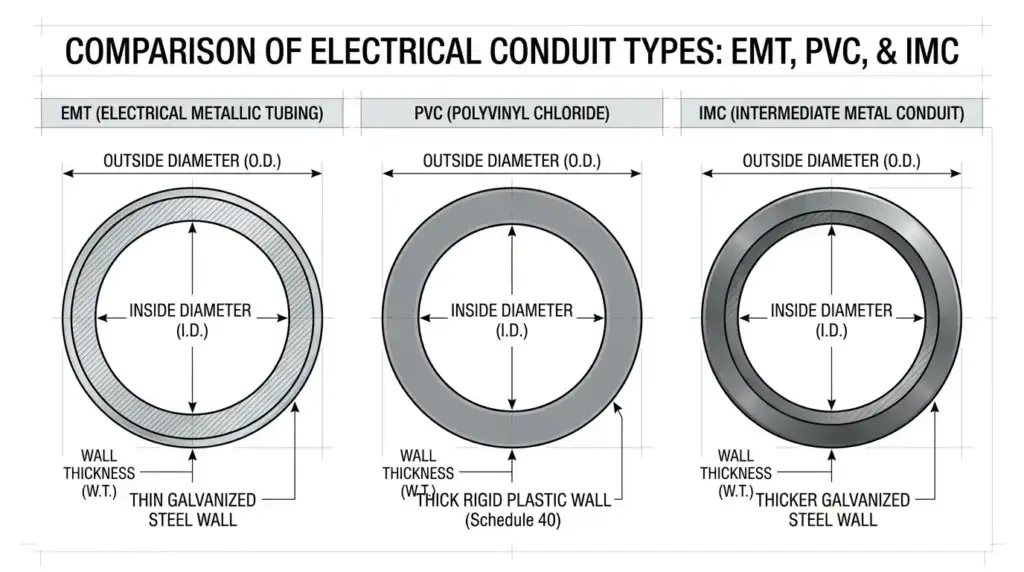
EMT and IMC are made from galvanized steel, while PVC is manufactured from plastic. Steel conduits offer greater impact resistance, whereas PVC provides superior protection against moisture and chemicals.
Weight
PVC is the lightest option, making transportation and installation easier. EMT is also relatively lightweight compared to other metal conduits. IMC weighs more because of its thicker steel walls but is still lighter than rigid metal conduit.
Strength
IMC provides the highest level of physical protection among these three conduit types.
If your installation is likely to experience heavy impacts or mechanical stress, IMC is generally the preferred option.
Corrosion Resistance
PVC performs best in corrosive environments because it cannot rust.
IMC also performs very well due to its galvanized coating.
EMT offers good corrosion resistance indoors but should be protected in harsh environments.
Cost
PVC is generally the least expensive option.
EMT usually costs more than PVC but less than IMC.
IMC has the highest material and installation costs because of its heavier construction and threaded connections.
Installation
PVC is easy to cut and glue together.
EMT is easy to bend and install using standard fittings.
IMC requires threading equipment and more installation time.
Indoor Applications
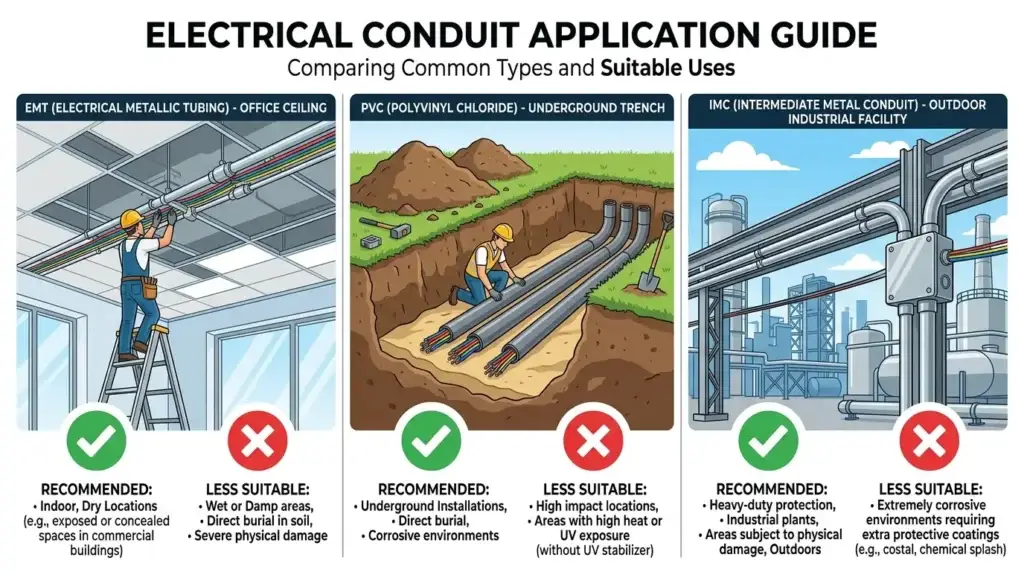
EMT is one of the most popular choices for indoor commercial wiring because it provides good protection while remaining easy to install.
PVC can also be used indoors where permitted, especially in areas exposed to moisture.
IMC is commonly selected for industrial buildings where additional protection is necessary.
Outdoor Applications
Outdoor installations expose conduit to sunlight, moisture, temperature changes, and physical damage.
PVC performs well in wet environments and underground systems.
IMC offers superior protection where equipment may be struck or damaged.
EMT may be suitable outdoors when installed according to code and protected against corrosion.
Underground Applications
PVC is widely used for underground electrical systems because it resists moisture, chemicals, and soil corrosion.
IMC can also be installed underground when properly protected.
EMT is generally not the preferred choice for direct burial applications.
Fire Resistance
Steel conduits such as EMT and IMC do not burn and provide excellent fire resistance.
PVC can soften or deform when exposed to high temperatures, although many products are listed for electrical use and meet applicable code requirements.
Electrical Grounding
One major difference between these conduit types is grounding.
EMT and IMC can serve as an equipment grounding path when installed correctly.
PVC is non-metallic, so a separate equipment grounding conductor is normally required.
Maintenance
PVC requires very little maintenance because it cannot rust.
EMT should be inspected periodically for signs of corrosion or mechanical damage.
IMC typically requires minimal maintenance and performs well in demanding environments.
Expected Lifespan
When installed correctly:
- PVC often lasts several decades underground.
- EMT provides many years of reliable service in dry indoor environments.
- IMC can remain in service for decades even in demanding industrial conditions.
Actual lifespan depends on installation quality, environmental conditions, and ongoing maintenance.
Which Conduit Is Best for Different Projects?
Residential Wiring
EMT is an excellent choice for exposed indoor wiring.
PVC works well for underground service entrances and outdoor circuits.
Commercial Buildings
EMT is commonly used because it balances cost, durability, and ease of installation.
Industrial Facilities
IMC is often preferred where equipment may experience vibration, impact, or harsh environmental conditions.
Outdoor Installations
PVC performs well in wet locations, while IMC offers better protection where physical damage is a concern.
Underground Electrical Runs
PVC is generally the most economical and corrosion-resistant solution for underground conduit systems.
How Conduit Type Affects Conduit Fill
Many people assume that a 1-inch EMT, a 1-inch PVC conduit, and a 1-inch IMC conduit all provide the same amount of usable space.
That is not always true.
Different conduit types have different wall thicknesses and internal diameters. Even though the trade size may be identical, the usable inside area can vary.
Because conduit fill calculations are based on the available internal area, changing the conduit type may change the maximum number of conductors that can be installed while remaining within NEC limits.
This is why electricians should always calculate conduit fill using the correct conduit type rather than assuming all 1-inch conduits have identical capacities.
If you need to verify the maximum conductor count for a specific conduit type and trade size, use a conduit fill chart instead of relying on estimates.
NEC Conduit Fill Considerations
The National Electrical Code limits how much of a conduit’s internal area may be occupied by conductors.
For most installations:
- One conductor may occupy up to 53% of the conduit area.
- Two conductors may occupy up to 31%.
- Three or more conductors are generally limited to 40% conduit fill.
These limits help reduce overheating, simplify wire pulling, and protect conductor insulation during installation.
Always verify conductor sizes, insulation type, and conduit dimensions before beginning an installation.
Common Mistakes When Choosing Conduit
Many installation problems occur because the conduit is selected without considering the project environment.
Common mistakes include:
- Choosing PVC where physical damage is likely.
- Assuming every 1-inch conduit has the same internal area.
- Ignoring conduit fill calculations.
- Forgetting grounding requirements when using PVC.
- Selecting conduit based only on material cost instead of long-term durability.
- Failing to follow local code requirements.
Avoiding these mistakes can improve safety, reduce installation time, and prevent costly modifications later.
Final Verdict
There is no single conduit that is best for every project.
EMT is an excellent all-around choice for indoor commercial and residential wiring because it combines affordability, durability, and simple installation.
PVC is ideal for underground systems and corrosive environments where rust resistance is the highest priority.
IMC offers the greatest strength and long-term protection, making it well suited for industrial facilities and demanding outdoor installations.
Before making your final decision, compare the installation environment, budget, mechanical protection requirements, and conduit fill capacity. Choosing the correct conduit today can improve system reliability, simplify installation, and help ensure compliance with the National Electrical Code for years to come.