
IMPORTANT
Executive Summary: Intermediate Metal Conduit (IMC) was specifically developed by metallurgists and electrical engineers in the 1970s as a modern, high-strength alternative to heavy Rigid Metal Conduit (RMC / GRC).
- Code Equivalence (NEC 342.10): Under the National Electrical Code, IMC is legally permitted everywhere RMC is allowed, including Class I, Division 1 hazardous explosion-proof locations.
- Weight Advantage: IMC is approximately 33% lighter than RMC, reducing worker fatigue, overhead ceiling loads, and shipping costs.
- Wire Capacity Bonus: Because IMC uses high-strength steel with a thinner wall, its inside diameter is larger, allowing up to 10% to 15% more wire fill per trade size.
- Cost Savings: IMC delivers 30% to 40% lower material costs and faster field-threading times.
Master Specification Matrix: RMC vs. IMC
The table below breaks down the exact physical dimensions, weights, and code specifications across common trade sizes.
| Trade Size | RMC Wall Thickness | IMC Wall Thickness | RMC Weight (per 100 ft) | IMC Weight (per 100 ft) | IMC Weight Savings | RMC 40% Fill Area | IMC 40% Fill Area | IMC Extra Wire Area |
|---|---|---|---|---|---|---|---|---|
| 1/2″ | 0.104 in. | 0.070 in. | 82 lbs | 62 lbs | 24.4% Lighter | 0.125 sq. in. | 0.141 sq. in. | +12.8% |
| 3/4″ | 0.113 in. | 0.075 in. | 109 lbs | 84 lbs | 22.9% Lighter | 0.219 sq. in. | 0.248 sq. in. | +13.2% |
| 1″ | 0.133 in. | 0.093 in. | 161 lbs | 119 lbs | 26.1% Lighter | 0.355 sq. in. | 0.400 sq. in. | +12.7% |
| 1-1/4″ | 0.140 in. | 0.095 in. | 218 lbs | 158 lbs | 27.5% Lighter | 0.610 sq. in. | 0.655 sq. in. | +7.4% |
| 1-1/2″ | 0.145 in. | 0.100 in. | 263 lbs | 194 lbs | 26.2% Lighter | 0.828 sq. in. | 0.889 sq. in. | +7.4% |
| 2″ | 0.154 in. | 0.105 in. | 350 lbs | 256 lbs | 26.9% Lighter | 1.363 sq. in. | 1.452 sq. in. | +6.5% |
| 2-1/2″ | 0.203 in. | 0.150 in. | 559 lbs | 441 lbs | 21.1% Lighter | 1.946 sq. in. | 2.054 sq. in. | +5.5% |
| 3″ | 0.216 in. | 0.150 in. | 727 lbs | 543 lbs | 25.3% Lighter | 3.000 sq. in. | 3.091 sq. in. | +3.0% |
| 3-1/2″ | 0.226 in. | 0.150 in. | 880 lbs | 629 lbs | 28.5% Lighter | 4.004 sq. in. | 4.004 sq. in. | Identical |
| 4″ | 0.237 in. | 0.150 in. | 1,030 lbs | 700 lbs | 32.0% Lighter | 5.153 sq. in. | 5.148 sq. in. | Identical |
RMC vs. IMC 5-Point Engineering Scorecard
Direct trade comparison for commercial & industrial installations
Metallurgical Difference: Why IMC is Thinner Yet Ultra-Strong
A common misconception among newer electrical apprentices is that thicker steel always equals a better installation.
- RMC (UL 6 Standard): Manufactured from standard structural low-carbon steel. Because the base metal has standard tensile strength, heavy wall thickness is required to achieve structural rigidity and pass UL impact tests.
- IMC (UL 1242 Standard): Manufactured from specialized, high-strength micro-alloy steel. This advanced metallurgical composition yields significantly higher tensile and yield strength per square millimeter.
Because the steel itself is stronger, IMC achieves equal or superior crush and beam-load ratings with a wall that is roughly one-third thinner.
Real Wire Fill Differences: NEC Annex C Table C.4 vs. Table C.8
Because IMC has a larger inside diameter than RMC in trade sizes from 1/2″ through 3″, it can hold more conductors before exceeding the NEC 40% fill limit.
The table below shows maximum allowable 12 AWG and 10 AWG THHN conductors in RMC vs. IMC:
| Conduit Trade Size | 12 AWG THHN in RMC (Table C.8) | 12 AWG THHN in IMC (Table C.4) | 10 AWG THHN in RMC (Table C.8) | 10 AWG THHN in IMC (Table C.4) | Wire Fill Gain with IMC |
|---|---|---|---|---|---|
| 1/2″ Trade Size | 9 wires | 10 wires | 5 wires | 6 wires | +1 Conductor |
| 3/4″ Trade Size | 16 wires | 18 wires | 10 wires | 11 wires | +2 Conductors |
| 1″ Trade Size | 26 wires | 30 wires | 16 wires | 18 wires | +2 to +4 Conductors |
| 1-1/4″ Trade Size | 45 wires | 49 wires | 28 wires | 31 wires | +3 to +4 Conductors |
| 1-1/2″ Trade Size | 62 wires | 66 wires | 39 wires | 42 wires | +3 to +4 Conductors |
| 2″ Trade Size | 102 wires | 109 wires | 64 wires | 68 wires | +4 to +7 Conductors |
For exact conductor counts across large feeder cables, check our master RMC conduit fill guide and our dedicated IMC conduit fill chart guide.
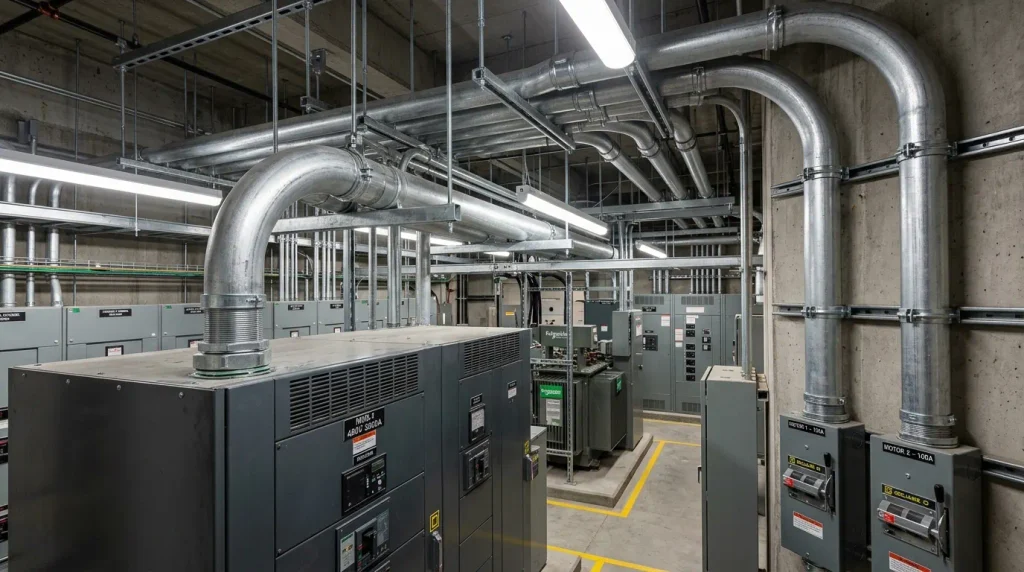
Threading, Bending & Tooling Considerations
Both conduits utilize standard National Pipe Taper (NPT) threads with a 3/4-inch taper per foot. This means all threaded fittings, locknuts, bushings, explosion-proof seal-offs, and cast conduit bodies are 100% interchangeable between RMC and IMC.
However, field fabrication differs substantially:
- Threading Dies and Equipment Wear: Because IMC has a thinner wall, pipe threading machines cut through less metal per joint. This reduces threading cycle time by 25% and dramatically extends the lifespan of expensive threading dies.
- Field Bending Tools: While 1/2″ and 3/4″ EMT can be bent with lightweight aluminum hand benders, IMC and RMC require heavy-duty ductile iron benders or mechanical/hydraulic benders. Always use a bender shoe specifically marked for IMC/Rigid to prevent conduit kinking or flattening.
- The 5-Thread Engagement Rule (NEC Article 500): In Class I, Division 1 and 2 hazardous locations, both RMC and IMC raceways must have at least 5 full threads fully engaged into explosion-proof enclosures and seal-off fittings to properly quench escaping electrical sparks.
Unless an engineering specification explicitly mandates “Heavy-Wall Galvanized Rigid Conduit (RMC) with no substitutions”, smart electrical contractors always submit an RFI or submittal to use IMC.
- Saves 35% on conduit material freight and purchase costs.
- Reduces ceiling hanger load by over 200 lbs per 100 feet on large trade sizes.
- Maintains 100% compliance with NEC Article 342 in all commercial, outdoor, and hazardous locations.
Cost and Weight Estimating: Real Project Example
Consider a commercial parking garage project requiring 2,000 feet of 2-inch threaded steel conduit:
- If Built with 2″ RMC:
- Total Weight: 7,000 lbs (350 lbs per 100 ft).
- Material Pipe Cost: ~16,000to20,000.
- Hanger Hardware: Requires heavy-duty structural anchors to carry 7,000 lbs of dead pipe weight.
- If Built with 2″ IMC:
- Total Weight: 5,120 lbs (256 lbs per 100 ft) — 1,880 lbs less weight on the ceiling structure.
- Material Pipe Cost: ~10,500to13,000 — $5,500+ direct material savings.
- Labor: Faster threading on ~200 pipe joints saves an estimated 15 to 20 journeyman labor hours.
Frequently Asked Questions (FAQs)
Yes. Under NEC 501.10(A)(1)(a), threaded Intermediate Metal Conduit (Article 342) is fully approved for Class I, Division 1 and 2 locations, exactly like RMC.
Yes. Both conduits use standard NPT threaded connections with the exact same thread pitch and taper (3/4″ per foot). Standard threaded couplings, conduit bodies (LB, LL, LR), and locknuts work identically on both.
Generally, no. Under NEC Section 250.118(3), threaded IMC is legally recognized as an approved equipment grounding conductor (EGC) with low electrical impedance.
No. Standard EMT benders are made of lightweight aluminum designed for thinwall tubing. Bending IMC in an EMT bender will likely crack the bender shoe or kink the conduit. You must use a ductile iron bender rated for IMC/Rigid conduit.
Related Sizing Tools & Pillar Guides
Explore Master Raceway Fill Hubs:
- Access the master IMC conduit fill chart guide for complete NEC Annex C Table C.4 data.
- Access the master RMC rigid metal conduit fill guide for Table C.8 data.
- Access the master EMT conduit fill chart guide for Table C.1 data.
- Read the comprehensive EMT vs PVC vs RMC conduit comparison guide.
Electrical Calculations & Code Tools:
- Calculate custom combinations with our Interactive Conduit Fill Calculator.
- Understand proper conduit spacing with the 24-inch nipple 60 percent fill rule.
- Prevent cable wedging during heavy pulls using our conduit jam ratio calculation guide