
IMPORTANT
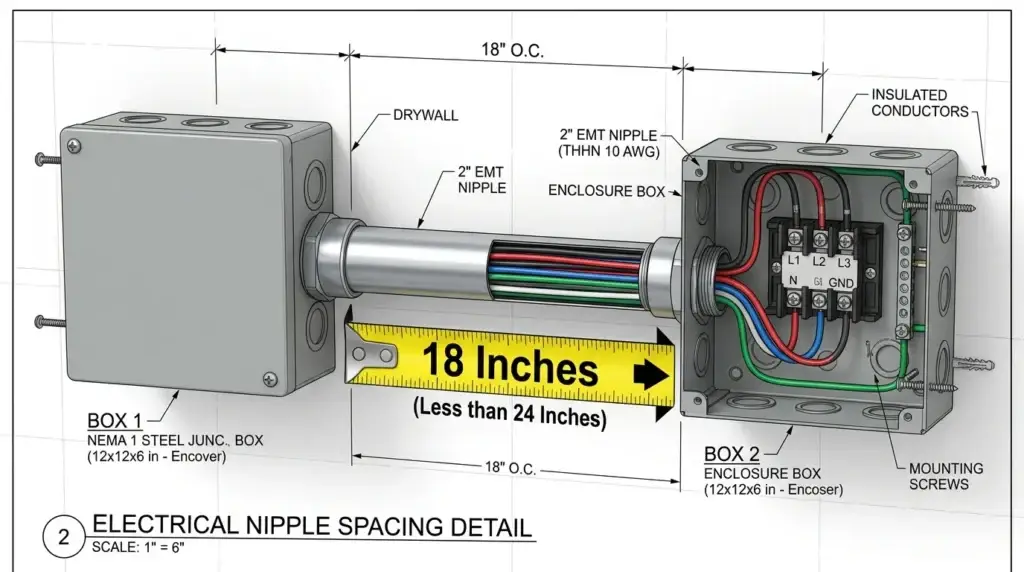
Quick Answer: Under National Electrical Code (NEC) Chapter 9, Table 1, Note 4, a conduit or tubing nipple that does not exceed 24 inches (600 mm) in length and is installed between boxes, cabinets, or similar enclosures is permitted to be filled up to 60 percent of its total internal cross-sectional area. In addition, current-carrying conductors inside a 24-inch or shorter nipple are exempt from standard ampacity derating penalties under NEC Section 310.15(C)(1).
Key Takeaways
- The Fill Allowance: Short nipples (24 inches or less) can be filled up to 60 percent of their internal area, compared to the standard 40 percent limit for raceways containing three or more conductors.
- No Ampacity Derating: You can pull more than three current-carrying conductors through a 24-inch nipple without applying ampacity reduction factors under NEC 310.15(C)(1).
- Enclosure to Enclosure Requirement: The 60 percent rule applies specifically to nipples installed between boxes, cabinets, troughs, or similar electrical enclosures.
- How Length Is Measured: The 24-inch limit applies to the length of the conduit or tubing pipe itself between enclosures, excluding connectors and fittings under recent NEC clarifications.
- The 24.1-Inch Trap: If a nipple exceeds 24 inches by even a fraction of an inch, it legally becomes a standard raceway. Maximum fill drops to 40 percent and full ampacity derating applies immediately.
What Is the 24-Inch Nipple Rule?
When electricians connect panelboards, junction boxes, wireways, or disconnect switches mounted close together, they frequently use short conduit segments called nipples.
Recognizing that short conduit sections dissipate heat differently than long raceways, the National Electrical Code provides a major physical and practical exception for short installations.
This exception is commonly known as the 24-Inch Nipple Rule.
Standard Raceway (Over 24 Inches): Maximum 40% Area Fill + Full Ampacity DeratingNipple Raceway (24 Inches or Less): Maximum 60% Area Fill + NO Ampacity Derating
The Twin Code Advantages: 60% Fill & Zero Derating
The 24-inch nipple rule provides two separate code benefits that make short electrical connections much easier to install.
Benefit 1: 60 Percent Cross-Sectional Fill Capacity
In standard conduit runs longer than 24 inches, NEC Chapter 9, Table 1 limits wire capacity based on the number of conductors:
- 1 conductor: Maximum 53 percent fill
- 2 conductors: Maximum 31 percent fill
- 3 or more conductors: Maximum 40 percent fill
However, NEC Chapter 9, Table 1, Note 4 overrides these numbers for short nipples:
“Conduit or tubing nipples not exceeding 24 in. (600 mm) in length installed between boxes, cabinets, and similar enclosures shall be permitted to be filled to 60 percent of their total cross-sectional area.”
This 60 percent limit applies regardless of whether you are pulling 1 wire, 3 wires, or 20 wires.
Benefit 2: Exemption from Ampacity Derating Penalties
Normally, when you pull more than three current-carrying conductors into a single raceway, NEC Section 310.15(C)(1) requires you to reduce (derate) the allowable ampacity of every conductor. For example, pulling 10 to 20 conductors forces you to cut wire ampacity by 50 percent.
However, NEC Section 310.15(C)(1) explicitly exempts nipples that do not exceed 24 inches.
Because heat generated inside a short conduit segment escapes quickly into the larger metal enclosures attached at both ends, thermal buildup is minimal. As a result, you do not have to derate conductor ampacity in a 24-inch nipple.
Standard Raceway vs. 24-Inch Nipple Comparison
| Code Feature | Standard Raceway (Length > 24″) | Conduit Nipple (Length ≤ 24″) |
|---|---|---|
| Primary Code Citation | NEC Chapter 9, Table 1 | NEC Chapter 9, Table 1, Note 4 |
| Max Fill (3+ Conductors) | 40 percent of internal area | 60 percent of internal area |
| Max Fill (1 or 2 Conductors) | 53% (1 wire) or 31% (2 wires) | 60 percent of internal area |
| Ampacity Derating (310.15) | Required for >3 current-carrying wires | NOT Required (Exempt) |
| Enclosure Requirement | Connects any raceway components | Must connect boxes, cabinets, or enclosures |
| Primary Installation Goal | Long-distance wire routing | Short interconnection between equipment |
How to Measure Nipple Length Legally
Getting the length measurement right is essential during an electrical inspection. A measurement mistake can turn a passing job into an immediate code violation.
Enclosure A ===> [ Connector ] ===== 24" Conduit Nipple ===== [ Connector ] <=== Enclosure BThe Code Rule for Measuring
- Enclosure to Enclosure Distance: Measure the distance between the two enclosures being connected. The total raceway span between the box knockouts must not exceed 24 inches.
- The Pipe Length Itself: The 2023 edition of the NEC clarified that the 24-inch limit applies to the length of the conduit or tubing pipe itself, excluding the threaded connectors or locknuts used to secure it to the boxes.
WARNING
Beware of Overall Assembly Length: While the NEC text specifies the conduit pipe length, some local building inspectors measure from the inside wall of Enclosure A to the inside wall of Enclosure B. To avoid job-site arguments, cut your conduit pipe so the entire assembly comfortably stays under 24 inches total.
Step-by-Step: How to Calculate 60% Nipple Fill
Calculating 60 percent nipple fill requires four straightforward steps.
Step 1: Determine Total Conduit Inside Area
Look up the total internal cross-sectional area of your conduit material in NEC Chapter 9, Table 4.
Total Conduit Area = Table Value from NEC Chapter 9, Table 4Step 2: Calculate the 60 Percent Allowable Fill Area
Multiply the total conduit inside area by 0.60.
Maximum Allowed Conductor Area = Total Conduit Area × 0.60Step 3: Calculate Total Conductor Area
Look up the individual area of each conductor in NEC Chapter 9, Table 5 (or manufacturer spec sheets) based on wire size (AWG or kcmil) and insulation type (THHN, XHHW, etc.). Multiply each wire area by the quantity of that wire, then add them together.
Total Conductor Area = (Wire 1 Area × Qty) + (Wire 2 Area × Qty) + ...Step 4: Verify Compliance
Check that the total conductor area is less than or equal to the 60 percent maximum allowed area.
Total Conductor Area ≤ Maximum Allowed Conductor AreaReal-World Job-Site Calculation Example
Imagine you are connecting an electrical main panelboard to an adjacent auxiliary wireway trough using a 2-inch EMT conduit nipple cut to 18 inches.
You need to pass the following THHN copper conductors through the nipple:
- 6 conductors of 4/0 AWG THHN
- 4 conductors of 1/0 AWG THHN
- 1 conductor of 2 AWG THHN (ground)
Step-by-Step Calculation:
- Find 2-Inch EMT Area: From NEC Chapter 9, Table 4, total internal area of 2-inch EMT = 3.356 square inches.
- Calculate 60% Max Area: 3.356 × 0.60 = 2.0136 square inches.
- Calculate Conductor Areas (NEC Table 5):
- 4/0 AWG THHN area = 0.3237 sq. in. × 6 wires = 1.9422 sq. in.
- 1/0 AWG THHN area = 0.1855 sq. in. × 4 wires = 0.7420 sq. in.
- 2 AWG THHN area = 0.1158 sq. in. × 1 wire = 0.1158 sq. in.
- Total Wire Area = 1.9422 + 0.7420 + 0.1158 = 2.8000 square inches.
- Evaluate Result: Total wire area (2.800 sq. in.) exceeds the 60% limit (2.0136 sq. in.).
- Solution: Upsize the nipple to a 2-1/2 inch EMT conduit (60% area = 2.864 sq. in.), which comfortably accepts all 11 conductors legally without derating!
The 24.1-Inch Trap: What Happens When You Exceed 24 Inches
A common installation error is installing a conduit nipple that measures 25 or 26 inches because of structural obstacles between boxes.
Exceeding the 24-inch limit triggers immediate code penalties:
| Feature | At 24.0 Inches | At 24.1 Inches |
|---|---|---|
| Raceway Classification | Conduit Nipple | Standard Raceway |
| Maximum Area Fill | 60 Percent | 40 Percent |
| 10 Current-Carrying Wires | 100% Ampacity (No Drop) | 50% Ampacity Drop (Derated) |
| Inspection Result | PASSES | FAILS |
[!COMMON MISTAKE] The Double Penalty: If your nipple measures 25 inches, you lose both code benefits at once. First, your maximum fill drops from 60 percent to 40 percent, making your conduit overfilled. Second, if you have 10 current-carrying conductors inside, you must reduce their ampacity by 50 percent under 310.15(C)(1), which often forces you to replace all the wire with larger gauge sizes.
Common Job-Site Applications for 60% Nipple Fill
Electricians rely on the 24-inch nipple rule in several standard installation scenarios:
- Panelboard to Trough / Wireway: Feeding multiple branch circuits from a circuit breaker panel into an overhead wireway trough.
- Main Disconnect to Subpanel: Connecting an outdoor main service disconnect to an indoor subpanel mounted back-to-back or side-by-side.
- Transformer to Panelboard: Interconnecting a dry-type step-down transformer to an adjacent distribution panelboard.
- Control Panel Gang Boxes: Connecting industrial control enclosures, push-button stations, or auxiliary gutters where dozens of control wires pass between cabinets.
Common Mistakes & Inspector Red Flags
Inspectors pay close attention to short conduit nipples. Avoid these frequent job-site mistakes:
- Open-Ended Nipples: Applying the 60 percent fill rule to a 12-inch nipple that feeds a light fixture or open junction box without an enclosure on both ends. Note 4 requires the nipple to be installed between boxes, cabinets, and similar enclosures.
- Ignoring Jam Ratio: Just because code allows 60 percent fill does not mean physical jamming cannot happen. When pulling three conductors of equal size through a nipple with a bend, check that the jam ratio is outside the 2.8 to 3.2 danger zone.
- Flexible Metal Conduit (FMC) Stretch: Cutting a piece of flexible conduit to 23 inches, but stretching it to 25 inches during installation. Always measure flexible conduit in its final installed position.
Practical Field Summary & Decision Checklist
Before completing a short conduit installation between enclosures, follow this field checklist:
- Step 1: Confirm the conduit nipple connects two enclosed boxes, cabinets, or troughs.
- Step 2: Measure the physical conduit pipe length to ensure it is 24 inches or less.
- Step 3: Find total conduit internal area from NEC Chapter 9, Table 4.
- Step 4: Calculate maximum allowed area: Total Area × 0.60.
- Step 5: Sum the individual cross-sectional areas of all conductors from NEC Chapter 9, Table 5.
- Step 6: Confirm total conductor area does not exceed the 60 percent limit.
- Step 7: Enjoy exemption from ampacity derating penalties under NEC 310.15(C)(1).
Frequently Asked Questions (FAQs)
Yes. NEC Chapter 9, Table 1, Note 4 applies to all recognized conduit and tubing types, including EMT, RMC, IMC, PVC (Schedule 40 and 80), FMC, and LFMC, as long as the length does not exceed 24 inches between enclosures.
Yes, provided the total cross-sectional area of all 30 conductors combined does not exceed 60 percent of the nipple’s internal cross-sectional area, and the nipple connects boxes or cabinets. Because derating under 310.15(C)(1) is exempt for nipples 24 inches or less, ampacity reduction is not required.
Yes. Equipment grounding conductors and bonding jumpers occupy physical space inside the raceway and must be included when calculating total conductor cross-sectional area.
A conduit nipple is a short length of conduit pipe (often cut on site or bought in standard lengths up to 24 inches) threaded at both ends or connected with fittings. A chase nipple is a tiny threaded fitting used to connect two boxes mounted back-to-back through touching knockouts without any pipe between them. Both qualify for the 60 percent fill rule.