
IMPORTANT
Executive Summary: While copper conductors conduct electricity identically, their outer insulation dictates where they can legally be installed under the National Electrical Code:
- THHN (Dry Only): Thermoplastic insulation with a clear nylon jacket. Rated for 90°C in dry indoor locations, but strictly prohibited in wet locations unless dual-rated.
- THWN-2 (Wet & Dry Standard): The default commercial building wire across North America. Dual-rated as THHN/THWN-2, it provides full 90°C ampacity ratings in both wet and dry conduit runs.
- XHHW-2 (Heavy-Duty Thermoset): Made from cross-linked polyethylene (XLPE). Does not melt during short-circuit faults, resists harsh industrial chemicals, provides superior moisture resistance, and is the mandatory choice for Variable Frequency Drive (VFD) motors and harsh underground feeders.
Which Wire Insulation Should You Install?
Fast selection based on environment and electrical duty
Master Specification Matrix: THHN vs. THWN-2 vs. XHHW-2
The table below summarizes the core technical, mechanical, and code-level characteristics across the three primary wire insulation types.
| Specification | Standard THHN | Dual-Rated THHN / THWN-2 | XHHW-2 (Modern Standard) |
|---|---|---|---|
| Insulation Material | Thermoplastic (PVC) | Thermoplastic (PVC) | Thermoset (Cross-linked Polyethylene / XLPE) |
| Outer Protective Jacket | Clear Nylon Coating | Clear Nylon Coating | None (Homogeneous XLPE wall) |
| Dry Temperature Rating | 90°C (194°F) | 90°C (194°F) | 90°C (194°F) |
| Wet Temperature Rating | Not Rated (Dry Only) | 90°C (194°F) | 90°C (194°F) |
| Underground Conduit Rating | Prohibited (Code Violation) | Approved (NEC 300.5(B)) | Approved (Maximum Durability) |
| Conductor Diameter | Compact (Thinner wall) | Compact (Thinner wall) | Slightly Larger (Thicker XLPE wall) |
| Conduit Fill Space | Maximizes wire count | Maximizes wire count | Consumes 5% to 18% more area |
| Pulling Friction Coefficient | Very Low (Slippery nylon) | Very Low (Slippery nylon) | Moderate (Requires pulling lube) |
| Short-Circuit Behavior | Melts and drips | Melts and drips | Non-melting (Chars, maintains spacing) |
| VFD / Corona Resistance | Poor (Dielectric degradation) | Poor (Dielectric degradation) | Superior (High dielectric strength) |
| Cold Weather Flexibility | Stiff/Brittle below 32°F | Stiff/Brittle below 32°F | Flexible down to -40°F |
Thermoplastic vs. Thermoset: The Critical Chemical Difference
The defining technical boundary between THHN/THWN-2 and XHHW-2 is how their molecular structures react to extreme heat:
1. Thermoplastic (PVC in THHN / THWN-2)
Thermoplastic polymers consist of linear molecular chains held together by weak intermolecular bonds:
- When heated, these molecular chains slide past one another. The plastic softens, liquifies, and melts.
- During high-amperage short-circuit faults or heavy overloads, the intense heat can melt the PVC insulation completely, causing the copper conductors to short against each other or weld to the steel conduit wall.
- In freezing winter conditions (below 32°F), PVC becomes glass-like and brittle, cracking if pulled aggressively around tight bends.
2. Thermoset (XLPE in XHHW-2)
Cross-linked polyethylene (XLPE) undergoes a vulcanization process that creates chemical cross-links between polymer chains, forming a permanent three-dimensional molecular grid:
- Thermoset polymers cannot melt. When subjected to extreme overload temperatures (exceeding 250°C during short circuits), XHHW-2 chars into an insulating carbonaceous layer that maintains physical separation between phase conductors.
- XLPE remains soft and pliable down to -40°F, eliminating cold-weather cracking on winter construction sites.
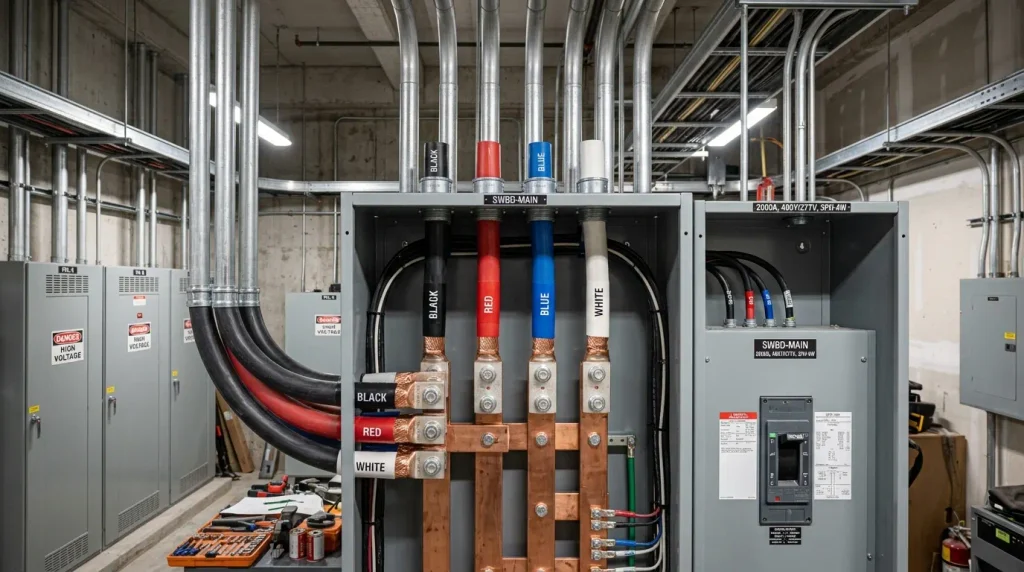
The Wet Location Trap: NEC 300.5(B) Underground Mandate
One of the most frequent code inspection failures on commercial projects involves underground conduits:
- The Code Definition (NEC Article 100): A wet location includes installations underground or in concrete slabs in direct contact with earth.
- The Condensation Reality (NEC 300.5(B)): Even if an underground PVC or steel conduit is 100% solvent-welded and watertight, atmospheric moisture entering through building enclosures will condense into liquid water inside the pipe. The interior of an underground raceway is legally classified as a wet location.
- The Code Trap: Standard pure THHN (which lacks the “W” moisture-resistant rating) is strictly illegal inside underground conduit runs.
- The Solution: You must install THWN-2 or XHHW-2. While most wire on the shelf today is dual-rated as
THHN/THWN-2, always verify the printed jacket legend before pulling conductors underground.
Conduit Fill Impact: THHN vs. XHHW-2 Dimensions
Because XHHW-2 does not utilize a nylon outer jacket, manufacturers apply a slightly thicker wall of cross-linked polyethylene to pass UL 44 physical abuse testing. Under NEC Chapter 9 Table 5, this makes XHHW-2 larger in diameter than THHN of the same wire gauge.
The table below shows the cross-sectional area comparison and how XHHW-2 can force you into a larger conduit size:
| Conductor Size | THHN Area (sq. in.) | XHHW-2 Area (sq. in.) | XHHW-2 Area Increase | 4 Conductors in EMT: THHN Size | 4 Conductors in EMT: XHHW-2 Size |
|---|---|---|---|---|---|
| 4 AWG Copper | 0.0824 sq. in. | 0.0973 sq. in. | +18.1% Larger | 1-1/4″ EMT | 1-1/4″ EMT |
| 1/0 AWG Copper | 0.1562 sq. in. | 0.1825 sq. in. | +16.8% Larger | 1-1/2″ EMT | 2″ EMT (Size Jump!) |
| 4/0 AWG Copper | 0.2679 sq. in. | 0.3197 sq. in. | +19.3% Larger | 2″ EMT | 2-1/2″ EMT (Size Jump!) |
| 350 MCM Copper | 0.5242 sq. in. | 0.6013 sq. in. | +14.7% Larger | 2-1/2″ EMT | 3″ EMT (Size Jump!) |
| 500 MCM Copper | 0.7073 sq. in. | 0.8316 sq. in. | +17.6% Larger | 3″ EMT | 3-1/2″ EMT (Size Jump!) |
WARNING
The Sizing Risk: If an estimator designs a conduit layout using standard THHN tables and the engineer later mandates XHHW-2 on submittals, large feeders (like 4/0 AWG or 500 MCM) will frequently exceed the 40% NEC fill limit, forcing an expensive upgrade to larger conduit and fittings! Always verify wire volume using our Interactive Conduit Fill Calculator.
Four 4/0 AWG copper conductors:
- 4x 4/0 THHN (1.072 sq. in. total): Fits legally in 2″ EMT conduit (1.342 sq. in. allowable fill).
- 4x 4/0 XHHW-2 (1.279 sq. in. total): Exceeds 2″ EMT limit when accounting for ground wire, forcing an upgrade to 2-1/2″ EMT conduit.
Why VFD Motors Mandate XHHW-2 Over THHN
In modern commercial and industrial buildings, Variable Frequency Drives (VFDs) control fans, chillers, and conveyor motors. However, VFD pulse-width modulation creates high-frequency voltage reflections that can destroy THHN wire:
- Reflected Wave Voltage Spikes: VFD outputs generate steep voltage wave fronts that reflect back from motor terminals, creating voltage spikes exceeding 1,200 to 1,600 volts on standard 480V systems.
- Dielectric Corona Breakdown: Thermoplastic PVC has a high dielectric dissipation factor. Under high-frequency voltage spikes, PVC heats up internally and suffers from localized electrical discharges known as corona breakdown. Within months, THHN insulation develops pinhole punctures, causing ground faults.
- The XHHW-2 Advantage: Cross-linked polyethylene (XLPE) possesses three times the dielectric strength and a much lower dissipation factor. Major drive manufacturers specifically require XHHW-2 or specialized VFD cable to prevent insulation failure.
Ampacity & Terminal Ratings: 75°C vs. 90°C Reality
Under NEC Table 310.16, THHN, THWN-2, and XHHW-2 all carry 90°C ampacity ratings in dry locations. However, you cannot automatically use the 90°C ampacity column to size your circuit breaker:
- NEC 110.14(C) Equipment Limitations: Most standard circuit breakers, disconnects, and distribution panels have terminal lugs rated for 75°C.
- The Sizing Rule: Under the NEC, you must size your final conductor ampacity based on the 75°C column to prevent overheating equipment terminals.
- The Derating Advantage: The 90°C rating is not useless; you are legally permitted to use the higher 90°C ampacity as your starting calculation point when applying ambient temperature correction factors (e.g., hot rooftops) or conduit fill adjustment factors (more than 3 current-carrying conductors in the same pipe).
Frequently Asked Questions (FAQs)
No. Standard THHN/THWN-2 cannot be buried directly in dirt without conduit. Only cables specifically listed and marked for direct burial (such as Type USE-2, UF-B, or direct-burial rated XHHW-2) are code-compliant without a raceway.
THHN has an outer extruded nylon jacket that is naturally smooth, slick, and abrasion-resistant. XHHW-2 has a pure cross-linked polyethylene surface that generates higher pulling friction against conduit walls, requiring generous application of cable pulling lubricant.
Yes. As long as all conductors have an insulation voltage rating equal to or exceeding the maximum circuit voltage (typically 600V), you can mix wire types in the same raceway. However, you must calculate conduit fill using each wire’s specific cross-sectional area from NEC Chapter 9 Table 5.
XHHW-2 typically costs 15% to 25% more than dual-rated THHN/THWN-2 for standard branch circuit sizes (14 AWG to 10 AWG). On large commercial feeder sizes (250 MCM to 500 MCM), the percentage price premium drops to approximately 10% to 15%.
Related Sizing Tools & Authority Guides
Explore Master Raceway Fill Hubs:
- Sizing conductors in thin-wall steel? Access the EMT conduit fill chart guide.
- Sizing conductors in plastic? Access the Schedule 40 PVC conduit fill chart guide.
- Sizing heavy industrial feeds? Access the RMC rigid metal conduit fill guide.
- Sizing intermediate steel? Access the IMC conduit fill chart guide.
Head-to-Head Comparisons & Code Rules:
- Read our EMT vs PVC vs RMC conduit comparison guide.
- Read our Metallic vs Non-Metallic conduit guide.
- Read our Conduit Bending vs Factory Elbows guide.
- Calculate custom multi-conductor combinations with our Interactive Conduit Fill Calculator.
- Prevent conductor wedging during heavy pulls with our conduit jam ratio calculation guide.