
IMPORTANT
Executive Summary: Choosing between EMT, PVC, and RMC comes down to four primary project variables: environment, physical impact risk, labor speed, and total budget:
- EMT (Electrical Metallic Tubing): Best for indoor commercial and residential dry branch circuits. Lightweight, low material cost, and fastest installation using set-screw or compression fittings.
- PVC (Rigid Polyvinyl Chloride): Best for underground direct burial trenches, wet outdoor locations, and corrosive environments. 100% rustproof and lightweight, joined via solvent weld.
- RMC (Rigid Metal Conduit): Best for heavy industrial facilities, hazardous classified areas, and service risers subject to severe physical damage. Highest strength and impact resistance, joined via threaded couplings.
Master Specification Comparison Matrix
The table below summarizes the key technical, mechanical, and economic differences across all three major raceway systems.
| Comparison Factor | EMT (Electrical Metallic Tubing) | PVC (Schedule 40 / 80) | RMC (Rigid Metal Conduit) |
|---|---|---|---|
| NEC Code Article | NEC Article 358 | NEC Article 352 | NEC Article 344 |
| Material Composition | Thin-wall galvanized carbon steel | Rigid polyvinyl chloride polymer | Heavy-wall hot-dip galvanized steel |
| Wall Thickness (3/4″) | 0.049 inches (Lightweight) | 0.113 in. (Sch 40) / 0.154 in. (Sch 80) | 0.113 inches (Heavy-Duty) |
| Joining Method | Set-screw or compression fittings | Primer and solvent cement glue | Threaded NPT hubs and couplings |
| Material Cost Rating | Low to Moderate ($) | Low (Sch 40) to Moderate (Sch 80) | High ($$$) |
| Installation Labor Speed | Very Fast (Easiest to bend & cut) | Fast (No threading; solvent cure time) | Slow (Heavy pipe, manual threading) |
| Impact Protection | Moderate (Standard commercial) | Low (Sch 40) / High (Sch 80) | Maximum (Severe abuse rated) |
| Corrosion Resistance | Poor outdoors / Dry indoor only | Excellent (Immune to rust & acids) | Excellent (Hot-dip zinc coating) |
| Grounding Path (EGC) | Yes (Listed fittings qualify) | No (Separate green wire required) | Yes (Threaded steel qualifies) |
| Underground Direct Burial | Restricted (Requires special coat) | Standard (NEC Table 300.5 at 18″) | Standard (NEC Table 300.5 at 6″) |
Which Conduit Should You Choose?
Fast Selection by Application and Environment
- Wiring indoor commercial offices, retail, or dry basements.
- Speed of installation and low labor costs are top priorities.
- You want hand-bendable pipe without threading tools.
- Trenching underground to garages, sheds, or yard lights.
- Wiring wet locations, car washes, or swimming pools.
- Complete immunity to chemical and rust corrosion is needed.
- Installing service entrance risers exposed to vehicles.
- Wiring hazardous Class 1 Division 1 industrial facilities.
- You need a shallow 6-inch underground burial depth.
Deep-Dive Profile: EMT (Electrical Metallic Tubing)
Electrical Metallic Tubing is the undisputed king of commercial interior electrical construction. Built from unthreaded, thin-wall rolled galvanized steel, EMT delivers solid mechanical protection while remaining lightweight and pliable enough to bend with a standard hand bender.
Advantages of EMT:
- Fastest Mechanical Assembly: Unthreaded slip-on couplings and connectors (set-screw or compression) install in seconds with a cordless driver.
- Effortless Field Bending: A skilled electrician can measure, notch, and execute 90-degree stubs, offsets, and saddles in minutes on the job site.
- Inherent Equipment Ground: When installed with listed fittings, EMT provides an approved equipment grounding return path per NEC 250.118(4).
- High Wire Fill Capacity: Thin steel walls give EMT a larger internal diameter than Schedule 80 PVC or RMC. Review the complete EMT conduit fill chart guide for exact wire counts.
Disadvantages of EMT:
- Corrosion Vulnerability: Thin galvanized coating will corrode rapidly when exposed to continuous moisture, soil acids, or coastal salt air.
- Limited Physical Protection: Thin walls can be crushed or deformed by heavy forklifts or construction machinery.
- Not Threaded: Cannot be used in explosion-proof hazardous locations.
Deep-Dive Profile: PVC Conduit (Schedule 40 & Schedule 80)
Rigid Polyvinyl Chloride (PVC) is the primary nonmetallic raceway across modern residential, commercial, and utility infrastructure. It is impervious to oxidation, moisture, rot, and electrochemical galvanic corrosion.
Advantages of PVC:
- 100% Corrosion Proof: Completely unaffected by water, high humidity, soil chemicals, chlorine vapors, and saltwater spray.
- Permanent Watertight Joints: Solvent-welded joints chemically fuse pipe and fittings together, creating a continuous waterproof seal.
- Lowest Material Cost: Schedule 40 PVC is generally the most affordable conduit material per linear foot. Review our PVC conduit fill chart guide for sizing.
- Heavy-Wall Option: Where physical protection is required above grade, Schedule 80 PVC conduit offers heavy-duty impact resistance.
Disadvantages of PVC:
- Zero Grounding Path: Because plastic is non-conductive, you must pull a dedicated green equipment grounding conductor in every circuit.
- Thermal Expansion Issues: PVC expands and contracts significantly with temperature swings (up to 4 inches per 100 feet over a 100°F shift), requiring expansion fittings.
- Temperature Brittleness: Becomes brittle in sub-zero freezing temperatures and can sag when exposed to direct rooftop heat.
Deep-Dive Profile: RMC (Rigid Metal Conduit)
Galvanized Rigid Metal Conduit (RMC / GRC) represents the gold standard of heavy-duty physical protection. Manufactured from thick-walled steel pipe with hot-dip galvanized interior and exterior surfaces, RMC is designed to withstand extreme industrial abuse.
Advantages of RMC:
- Maximum Impact Resistance: Capable of withstanding vehicle strikes, flying debris, and heavy industrial machinery impacts without compromising enclosed conductors.
- Hazardous Location Rated: Approved for Class I, Division 1 explosion-proof installations where threaded joints contain internal electrical arcs.
- Shallow 6-Inch Burial: Under NEC Table 300.5, RMC can be buried at a depth of only 6 inches under dirt or rock, saving enormous excavation labor. Check our RMC conduit fill guide for feeder sizing.
- Bulletproof Grounding Continuity: Heavy threaded steel couplings provide the lowest impedance grounding return path available in electrical construction.
Disadvantages of RMC:
- High Material & Freight Cost: Heavy steel makes RMC the most expensive raceway material to purchase and transport.
- Slow, Labor-Intensive Installation: All field cuts require manual pipe threading, cutting oil, and reaming, requiring specialized power threaders.
- Difficult Field Bending: Bending RMC above 1-inch trade size requires expensive electric or hydraulic benders.
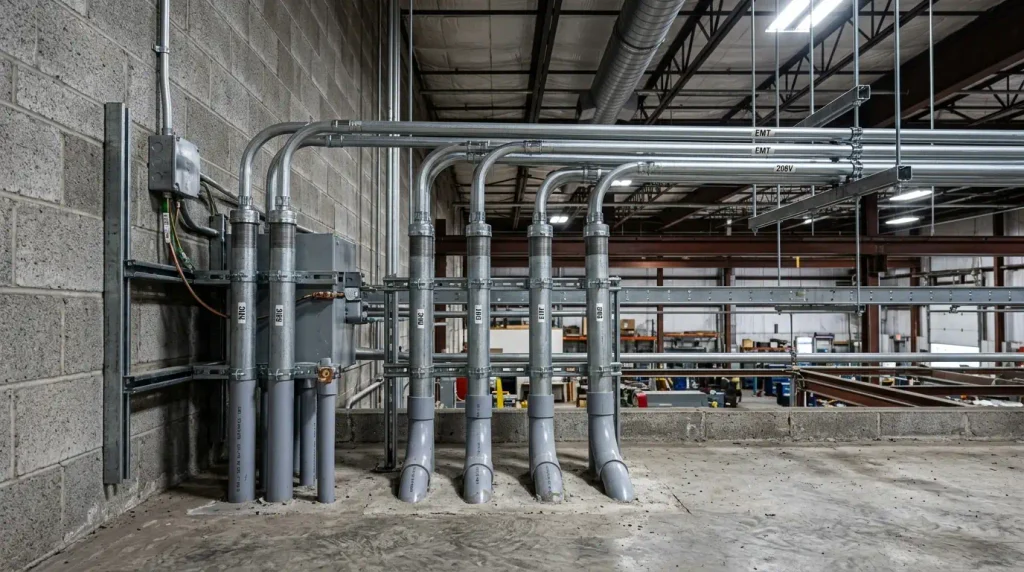
Critical Factor Breakdown: Side-by-Side Comparison
To help you calculate trade-offs on commercial job bids, let’s examine the three raceways across key real-world metrics.
1. Total Installed Cost (Material vs. Labor)
While PVC Schedule 40 is the cheapest pipe material, labor dynamics often change the equation:
- EMT: Lowest total installed cost for indoor dry work. Fast set-screw fittings and lightweight handling make labor 25% to 35% faster than threaded steel.
- PVC: Lowest total installed cost for underground trenching. Fast solvent welding and light weight offset the requirement to pull an extra ground wire.
- RMC: Highest total installed cost. Material costs are 2x to 3x higher than EMT, and pipe threading operations increase installation labor by 40% to 60%.
2. Physical Protection and Abuse Resistance
- RMC: Ranked #1. The only choice where heavy vehicles, cranes, or machinery operate adjacent to electrical lines.
- Schedule 80 PVC: Ranked #2. Approved by NEC 352.10(F) for areas subject to physical damage, but cannot match the absolute shear strength of steel.
- EMT: Ranked #3. Sufficient for typical commercial office, commercial retail, and residential protection, but vulnerable to heavy direct impact.
The Pro Contractor’s Hybrid Strategy
Professional commercial electrical contractors rarely use just one conduit type across an entire facility. Instead, they engineer a hybrid raceway design that matches each material to its optimal zone:
- Underground Distribution: Run lightweight, corrosion-proof Schedule 40 PVC in all horizontal underground dirt trenches.
- Transition at Grade: Convert from PVC to Schedule 80 PVC or RMC for the vertical riser emerging from the dirt or concrete slab to protect against weed trimmers, lawnmowers, and vehicle bumpers.
- Interior Overhead Branching: Once inside the building envelope above 8 feet, transition to cost-effective, lightweight EMT for all overhead lighting and power drops.
Frequently Asked Questions (FAQs)
The raw material cost of Schedule 40 PVC is slightly lower than EMT. However, for indoor dry installations, EMT is often cheaper overall because its slip-on set-screw fittings install faster than solvent-welded PVC and it does not require pulling an extra ground wire.
EMT is permitted in outdoor wet locations under NEC 358.10(C) only if installed with listed rain-tight compression fittings and weatherproof boxes. However, for underground direct burial or continuous moisture, PVC or RMC is preferred.
RMC is mandatory in Class I, Division 1 hazardous locations (such as gas stations and spray paint booths), in industrial facilities subject to severe physical impacts, or where an engineer specifies heavy threaded steel for structural shielding.
Yes. Because PVC is non-conductive plastic, it cannot carry electrical fault current. Under NEC Section 250.118 and 352.60, an insulated or bare equipment grounding conductor must be pulled through PVC raceways.
Related Sizing Tools & Authority Guides
Explore Master Raceway Fill Hubs:
- Access the master EMT conduit fill chart guide for complete Annex C Table C.1 data.
- Access the master Schedule 40 PVC conduit fill chart guide for Annex C Table C.10 data.
- Access the master Schedule 80 PVC conduit fill guide for heavy-wall Table C.9 data.
- Access the master RMC rigid metal conduit fill guide for Table C.8 data.
Essential Electrical Rules & Tools:
- Use our live Interactive Conduit Fill Calculator for multi-conductor combinations.
- Learn how to avoid wire lockup with our conduit jam ratio calculation guide.
- Take advantage of short runs using the 24-inch nipple 60 percent fill rule.