
IMPORTANT
Executive Summary: Choosing between metallic raceways (EMT, IMC, RMC) and non-metallic systems (PVC, LFNC, HDPE, RTRC Fiberglass) is one of the most critical engineering decisions on any project.
- Grounding & Shielding (NEC 250.118): Metallic steel conduit acts as an inherent equipment grounding conductor and blocks up to 95% of electromagnetic interference (EMI). Non-metallic conduit provides zero EMI shielding and requires pulling a dedicated copper ground wire in every run.
- Thermal Movement: PVC expands at 5 times the rate of steel (4.06 inches per 100 feet per 100°F shift), requiring engineered expansion fittings to prevent rooftop buckling.
- Corrosion & Soil Chemistry: Non-metallic raceways are 100% immune to rust, coastal salt spray, and acidic soils.
- Underground Trenching (NEC Table 300.5): Rigid steel conduit only requires 6 inches of trench burial depth under turf compared to 18 inches for PVC, cutting rocky excavation labor by up to 66%.
Conduit Selection by Application Environment
Fast-track engineering decisions based on site operating conditions
Master Engineering Raceway Matrix
The table below provides a comprehensive physical, mechanical, and code-level comparison between the five primary metallic and non-metallic conduit categories.
| Raceway System | NEC Code Article | Material Composition | 1″ Weight per 100 ft | Impact & Crush Rating | Support Spacing (1″ Size) | Equipment Grounding Path (EGC) | 60 Hz EMI Shielding |
|---|---|---|---|---|---|---|---|
| EMT (Thinwall) | NEC Article 358 | Galvanized carbon steel | 67 lbs | Moderate to High | 10 feet | Inherent (NEC 250.118(4)) | Up to 95% attenuation |
| IMC (Intermediate) | NEC Article 342 | High-strength alloy steel | 119 lbs | Severe abuse rated | 10 to 12 feet | Inherent (NEC 250.118(3)) | Up to 95% attenuation |
| RMC (Rigid Metal) | NEC Article 344 | Heavy hot-dip galvanized steel | 161 lbs | Maximum physical protection | 10 to 12 feet | Inherent (NEC 250.118(2)) | Up to 95% attenuation |
| PVC (Schedule 40) | NEC Article 352 | Polyvinyl chloride polymer | 32 lbs | Moderate (Not abuse rated) | 3 feet | None (Separate wire required) | 0% (Transparent to fields) |
| PVC (Schedule 80) | NEC Article 352 | Thick-wall PVC polymer | 43 lbs | High (NEC 352.10(F) rated) | 3 feet | None (Separate wire required) | 0% (Transparent to fields) |
| Fiberglass (RTRC) | NEC Article 355 | Reinforced thermosetting resin | 20 lbs | High (Type XW severe rated) | 10 feet | None (Separate wire required) | 0% (Transparent to fields) |
Grounding Mechanics & EMI Shielding Physics
The most fundamental electrical difference between metal and plastic raceways lies in electrical conductivity and magnetic permeability.
1. Equipment Grounding Conductor Path (NEC 250.118)
- Metallic Raceways: Steel conduits (EMT, IMC, and RMC) are approved Equipment Grounding Conductors under NEC 250.118. Their low electrical impedance provides an immediate, continuous path for fault currents to return to the service panel and trip the circuit breaker in milliseconds.
- The Healthcare Redundant Grounding Rule (NEC 517.13): In patient care spaces, life-safety codes mandate two independent grounding paths. The metal raceway itself must serve as the primary ground, supplemented by an insulated copper grounding wire inside.
- Non-Metallic Raceways: PVC, HDPE, and RTRC are electrical insulators. Under NEC 352.60 and 355.60, an insulated or bare equipment grounding conductor must be sized per NEC Table 250.122 and pulled through every run. This consumes 15% to 25% of allowable conduit fill area and adds material cost.
2. The Georgia Tech GEMI Study: 60 Hz Magnetic Shielding
A landmark study conducted by the Georgia Institute of Technology and the Steel Tube Institute evaluated electromagnetic interference (EMI) across electrical raceways:
- The Faraday Cage Myth: While any metal (including aluminum) blocks high-frequency electric fields, 60 Hz power line noise is primarily a low-frequency magnetic field.
- Magnetic Permeability: Non-ferrous materials like aluminum and PVC have a relative magnetic permeability of 1 (identical to air), providing zero magnetic field attenuation.
- Carbon Steel Performance: Steel conduit has a relative magnetic permeability ranging from 100 to over 500. It acts as a magnetic flux shunt, attenuating 60 Hz electromagnetic fields by up to 95%. In commercial buildings with sensitive data cables, hospital telemetry, or audio equipment, steel conduit prevents dangerous electromagnetic cross-talk.
Thermal Expansion Dynamics: The Rooftop Failure Scenario
Temperature fluctuations cause dramatic physical movement differences between metal and plastic conduits.
Thermal Expansion Comparison Table (per 100 ft per 100°F Shift)
- Schedule 40 & 80 PVC: Expands 4.06 inches (NEC Table 352.44)
- Fiberglass (RTRC): Expands 1.64 inches (NEC Table 355.44)
- Aluminum Conduit: Expands 1.62 inches (NEC Section 300.7(B))
- Steel Conduit (EMT, IMC, RMC): Expands 0.81 inches (NEC Section 300.7(B))
PVC expands at 5 times the rate of steel. On a commercial rooftop with a 200-foot run subject to seasonal temperature swings from 20°F in winter to 140°F under direct summer sun (a 120°F differential), PVC expands:
Expansion = 200 ft x (4.06 in / 100 ft) x (120°F / 100°F) = 9.74 inches
Without specialized expansion fittings installed every 40 to 50 feet, the PVC will buckle into an S-curve, rip off support struts, and crack terminal adapters at junction boxes. Steel over the same run expands only 1.95 inches.
The 2023 NEC Frost Heave Requirement (NEC 352.44(B))
The 2023 National Electrical Code mandates expansion-deflection slip fittings where underground PVC emerges above grade into fixed service equipment. In freezing climates, frozen ground expands upward (frost heave) and then settles in spring. Rigid PVC risers without expansion sleeves regularly shear off at the below-ground elbow or pull electrical meter bases clean off residential foundations.
Fire Safety, Toxicity & Smoke Pyrolysis
In building fire scenarios, conduit material performance directly impacts occupant survival and equipment survivability:
- Non-Combustible Steel (EMT/IMC/RMC): Steel possesses a Class A fire rating. It will not melt, combust, or contribute fuel. It maintains structural containment up to 1,800°F, generating zero smoke and zero toxic off-gassing.
- PVC and Hydrogen Chloride (HCl) Poisoning: Polyvinyl chloride contains approximately 57% chlorine by weight. When exposed to flame above 390°F, PVC undergoes thermal degradation, releasing massive volumes of Hydrogen Chloride (HCl) gas. When inhaled, HCl reacts with moisture in human lungs to form concentrated Hydrochloric Acid, causing pulmonary edema.
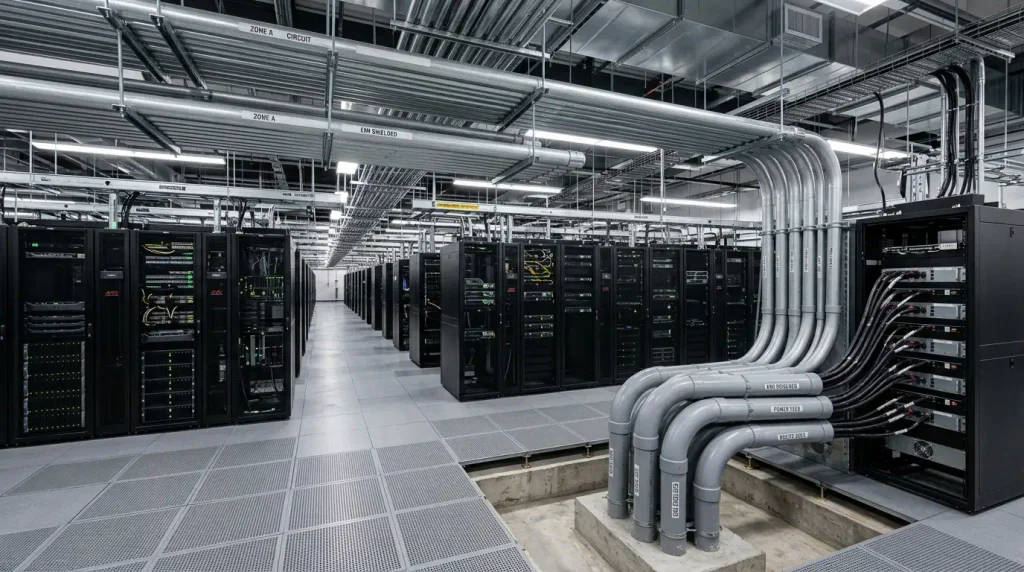
- Secondary Acid Corrosiveness in Data Centers: Airborne HCl gas travels through HVAC ventilation ducts, condensing onto server motherboards, microprocessors, and copper busbars, etching circuit traces and causing catastrophic electronic failure throughout the facility.
- Transit Standards (NFPA 130 and NFPA 502): In mass transit rail systems and road tunnels, combustible halogenated plastics like standard PVC are banned. Engineers specify Low-Smoke Zero-Halogen (LSZH) materials, steel, or Fiberglass RTRC to prevent toxic smoke asphyxiation.
Underground Burial Reality: The 6-Inch Trench Advantage
A common industry misconception is that PVC is always cheaper for underground runs. However, trenching labor dictated by NEC Table 300.5 frequently flips the economic equation.
NEC Table 300.5 Minimum Cover Requirements (0 to 1000 Volts)
- Under Turf / Normal Dirt (Column 2 vs. Column 3):
- RMC & IMC: Requires only 6 inches of cover.
- PVC & Non-Metallic: Requires a minimum of 18 inches of cover.
- Under Commercial Driveways & Parking Lots:
- RMC & IMC: Requires 18 inches of cover.
- PVC & Non-Metallic: Requires 24 inches of cover.
In rocky terrain, coral, hardpan soil, or congested city sidewalks with underlying utilities, digging an 18-inch trench requires heavy hydraulic excavators or vacuum trucks. Digging a shallow 6-inch trench for RMC reduces excavated soil volume by up to 66%, often making RMC the faster and less expensive underground installation overall.
• Zero extra copper ground wire cost
• 5.5 – 6.5 NECA labor hours
• Lowest Indoor Cost
• Separate #8 copper ground required
• Heating blankets required for bends
• Lowest Trench Cost
Total Installed Cost (TIC): Why Stick Price is Deceptive
Electrical estimators who look only at material cost per 10-foot stick often underestimate PVC installations:
- The 3-Foot Support Rule (NEC Table 352.30): While 1-inch EMT or RMC can span 10 feet between structural hangers, 1-inch PVC must be supported every 3 feet. For a 100-foot overhead run, EMT requires 10 hangers, while PVC requires 33 hangers. The additional strut, all-thread rod, beam clamps, and drilling labor substantially erode material savings.
- Cable Pulling Friction & Burn-Through: The dynamic coefficient of friction of PVC (0.50 to 0.55) is significantly higher than steel (0.35 to 0.40). During high-tension utility cable pulls around 90-degree sweeps, pulling ropes can saw through PVC elbows via friction heating. Engineering specifications routinely mandate RMC factory steel elbows on underground PVC conduit runs.
Top 6 Field Mistakes & Code Violations to Avoid
- Omitting the Ground Wire in PVC (NEC 352.60): Apprentices moving from indoor EMT to outdoor PVC often forget to pull an equipment grounding conductor.
- Installing Schedule 40 in Vehicle Traffic Areas (NEC 352.12(C)): Schedule 40 PVC is prohibited where subject to physical damage. Use Schedule 80 PVC, IMC, or RMC near loading docks and driveway bollards.
- Forgetting Solar Roof Adder on Expansion Joints (NEC 352.44): Solar heat gain can elevate rooftop ambient temperatures by 30°F to 60°F, creating severe expansion buckling if uncalculated.
- Ignoring Schedule 80 Internal Diameter Restrictions (NEC Chapter 9 Table 4): Schedule 80 has very thick walls. Pulling the same number of conductors into Schedule 80 as EMT will exceed the 40% fill limit, causing cable jams. Always verify with our Interactive Conduit Fill Calculator.
- Combustible PVC in Return Air Plenums (NEC 300.22): Standard PVC cannot be installed in environmental air spaces where smoke spreads rapidly through ventilation ducts.
- Omitting Riser Expansion Fittings (NEC 352.44(B)): Failing to install slip joints on direct-burial risers where winter soil frost heave shears rigid plastic piping.
Frequently Asked Questions (FAQs)
Yes. Steel conduit creates a continuous, bonded metallic shield that safely shunts high-voltage lightning surge energy to earth ground, shielding enclosed conductors from severe inductive voltage spikes.
Yes. It is standard commercial practice to use Schedule 40 PVC underground and transition via a threaded female adapter to a rigid steel riser or EMT conduit above grade once inside the building envelope.
Because PVC is a thermoplastic, it softens at higher temperatures and sags under its own weight. NEC Table 352.30 mandates support spacing every 3 feet for 1-inch PVC, whereas EMT spans 10 feet per NEC 358.30.
Fiberglass (RTRC) offers superior temperature performance (-60°F to +250°F), expands 60% less than PVC, spans 10 feet between hangers, releases zero halogens in fires, and prevents cable burn-through during heavy pulls. However, material fittings are more specialized.
Related Sizing Tools & Authority Guides
Explore Master Raceway Fill Hubs:
- Access the master EMT conduit fill chart guide for complete Annex C Table C.1 data.
- Access the master Schedule 40 PVC conduit fill chart guide for Table C.10 data.
- Access the master Schedule 80 PVC conduit fill guide for heavy-wall Table C.9 data.
- Access the master RMC rigid metal conduit fill guide for Table C.8 data.
- Access the master IMC conduit fill chart guide for Table C.4 data.
Head-to-Head Comparisons & Code Rules:
- Read our complete EMT vs PVC vs RMC conduit comparison guide.
- Read our technical RMC vs IMC conduit comparison guide.
- Calculate custom multi-conductor combinations with our Interactive Conduit Fill Calculator.
- Understand proper conduit spacing using the 24-inch nipple 60 percent fill rule.
- Prevent conductor wedging during heavy pulls with our conduit jam ratio calculation guide