
If you’re new to electrical work, you’ve probably heard the terms conduit fill and box fill. Many people think they mean the same thing, but they do not. Both are important for safe electrical installations, yet each measures something different and follows different NEC rules.
Understanding the difference between conduit fill and box fill helps you avoid wiring problems, reduce the risk of overheating, and pass electrical inspections. Whether you’re an electrician, apprentice, contractor, or DIY homeowner, learning these two concepts will make your installations safer and more efficient.
If you need to calculate conduit capacity quickly, you can use our free Conduit Fill Calculator to find the correct conduit size based on your conductors.
What Is Conduit Fill?
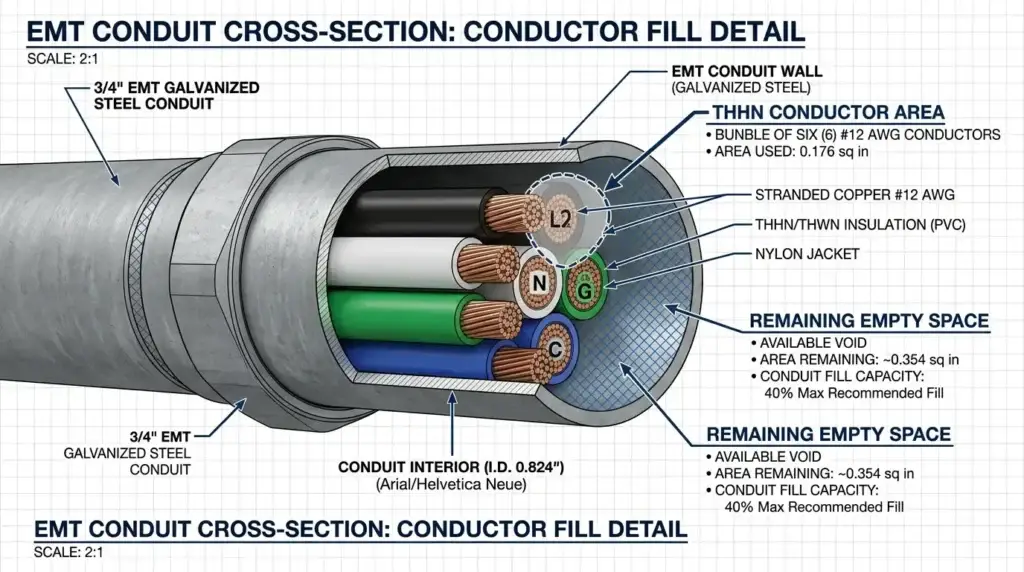
Conduit fill is the amount of space that electrical wires occupy inside a conduit. A conduit protects electrical wires from physical damage, moisture, and other environmental hazards. However, a conduit should never be packed with too many wires.
The National Electrical Code (NEC) sets limits on how much of a conduit can be filled. These limits help keep wires safe and make installation easier.
Simply put, conduit fill answers one question:
Do all of these wires fit safely inside this conduit?
If the answer is no, you need a larger conduit or fewer conductors.
Why Conduit Fill Matters
A proper conduit fill calculation offers several important benefits.
- Prevents wires from overheating
- Makes pulling wires easier
- Protects wire insulation from damage
- Reduces installation time
- Helps electricians meet NEC requirements
- Improves long-term reliability
When a conduit is overfilled, pulling conductors becomes difficult. Excess pressure can damage insulation, increasing the risk of electrical faults later.
How Conduit Fill Is Measured
Conduit fill is based on two measurements:
- The internal cross-sectional area of the conduit
- The total cross-sectional area of all conductors
The NEC provides tables that specify how much of the conduit can be occupied based on the number of conductors.
For example:
- One conductor may use up to 53% of the conduit.
- Two conductors may use up to 31%.
- Three or more conductors may use up to 40%.
These percentages help maintain safe spacing inside the conduit.
If you’re unfamiliar with the basics, read our guide on What Is Conduit Fill? before continuing.
What Is Box Fill?
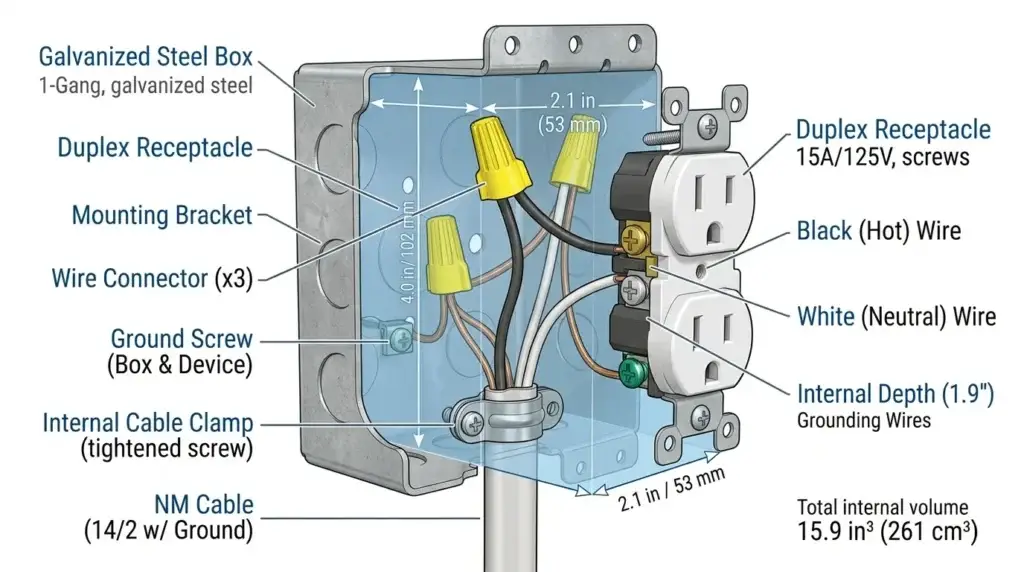
Box fill refers to the amount of space available inside an electrical box. Electrical boxes are used for switches, outlets, junctions, and other wiring connections.
Every wire, device, clamp, and grounding conductor inside the box occupies a certain amount of volume.
Box fill calculations determine whether all these components fit safely inside the electrical box.
Instead of measuring area like conduit fill, box fill measures volume.
Why Box Fill Matters
An overcrowded electrical box creates several problems.
- Wires become difficult to arrange.
- Insulation may become damaged.
- Devices are harder to install.
- Future repairs become more difficult.
- Heat can build up inside the box.
- Electrical inspections may fail.
Proper box sizing provides enough room for safe wire connections and maintenance.
How Box Fill Is Calculated
Several items count toward box fill.
These include:
- Current-carrying conductors
- Equipment grounding conductors
- Switches and receptacles
- Internal cable clamps
- Support fittings
Each item has a specific volume allowance based on conductor size. The total must not exceed the volume rating of the electrical box.
Unlike conduit fill, which focuses on conduit capacity, box fill focuses on the available space inside the box.
Conduit Fill vs Box Fill: Side-by-Side Comparison
| Feature | Conduit Fill | Box Fill |
|---|---|---|
| Purpose | Measures wire space inside conduit | Measures available volume inside a box |
| Measured By | Cross-sectional area | Cubic volume |
| Applies To | Electrical conduits | Electrical boxes |
| Main Goal | Prevent overfilled conduit | Prevent overcrowded boxes |
| NEC Coverage | Chapter 9 and related tables | Article 314.16 |
| Includes Devices | No | Yes |
| Includes Internal Clamps | No | Yes |
| Inspection Focus | Proper conduit sizing | Proper box sizing |
Although both calculations involve electrical conductors, they solve different problems.
Key Differences Between Conduit Fill and Box Fill
Understanding the differences makes electrical planning much easier.
Where Each Calculation Applies
Conduit fill applies to wiring raceways such as:
- EMT conduit
- PVC conduit
- Rigid Metal Conduit (RMC)
- Intermediate Metal Conduit (IMC)
- Flexible conduit
Box fill applies to:
- Junction boxes
- Switch boxes
- Outlet boxes
- Ceiling boxes
- Device boxes
If there is no conduit, conduit fill does not apply. If there is no electrical box, box fill does not apply.
What Each Calculation Measures
Conduit fill measures the percentage of conduit occupied by conductors.
Box fill measures the total volume occupied inside an electrical box.
Although both involve conductors, the calculations use different measurements and different NEC requirements.
NEC Rules Compared
Conduit fill calculations are primarily based on NEC Chapter 9 and related conduit fill tables.
Box fill calculations are covered under NEC Article 314.16.
Using the correct NEC section is important because each calculation follows different rules.
Common Calculation Factors
Conduit fill depends on several factors.
These include:
- Conductor size
- Number of conductors
- Conduit material
- Conduit trade size
- Insulation type
Box fill depends on different factors.
These include:
- Number of conductors
- Equipment grounding conductors
- Devices
- Internal clamps
- Box volume
Even though some factors overlap, the final calculations are completely different.
Can You Pass One Calculation but Fail the Other?
Yes.
This is one of the most common mistakes beginners make.
Imagine you install four conductors inside a properly sized ¾-inch EMT conduit.
Your conduit fill calculation shows everything is within NEC limits.
However, all four conductors enter a small junction box with two switches and internal clamps.
Now the box may not provide enough volume for all those components.
In this case:
- Conduit fill passes.
- Box fill fails.
The opposite situation can also happen.
A large junction box may provide plenty of room, but the conduit connected to it may be too small for the number of conductors.
That means:
- Box fill passes.
- Conduit fill fails.
Both calculations must meet NEC requirements before an installation is considered compliant.
Example: Conduit Fill vs Box Fill
Let’s look at a simple example.
Suppose you have:
- Four THHN conductors
- One ¾-inch EMT conduit
- One standard metal junction box
First, calculate the conduit fill.
Using conduit fill tables or an online calculator, you verify that four conductors fit safely inside the selected conduit.
Next, calculate the box fill.
You count:
- Four conductors
- One equipment grounding conductor
- One switch
- Internal clamp
Now compare the required volume with the rated volume of the junction box.
If the required volume exceeds the box rating, you’ll need a larger electrical box even though the conduit size is correct.
This example shows why both calculations are necessary.
Common Mistakes Electricians Make
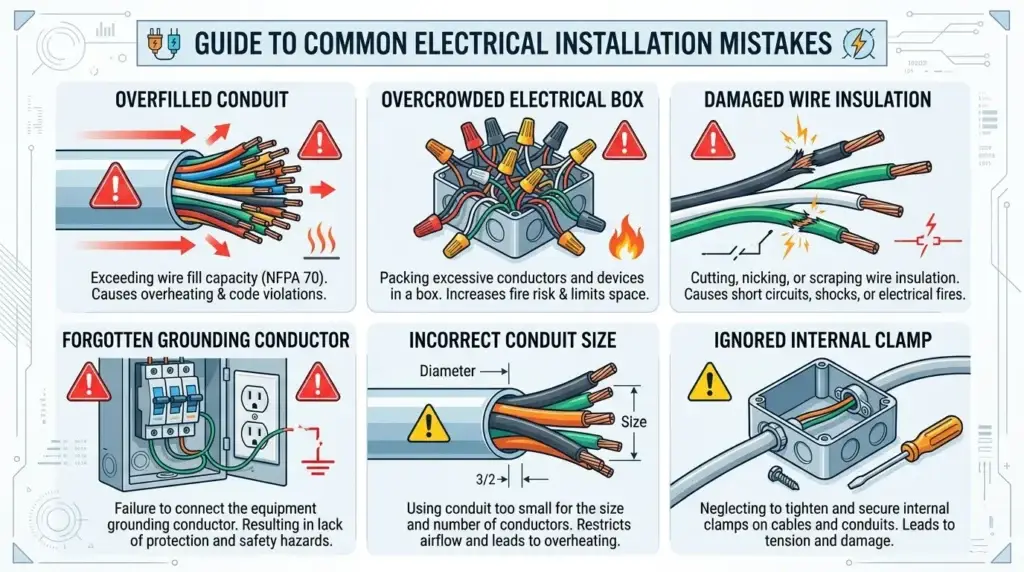
Even experienced installers occasionally make mistakes.
Here are some of the most common ones.
Confusing Conduit Fill with Box Fill
Many beginners assume both calculations measure the same thing.
They do not.
Each serves a different safety purpose.
Forgetting Equipment Grounds
Grounding conductors may affect box fill calculations.
Leaving them out can produce incorrect results.
Ignoring Internal Clamps
Internal clamps occupy valuable space inside the electrical box.
They should always be included when required.
Using the Wrong Conductor Size
Every conductor size has a different cross-sectional area and volume allowance.
Using incorrect values can lead to calculation errors.
Choosing the Wrong Conduit Type
Different conduit materials have different internal dimensions.
Always verify the conduit type before calculating fill.
Assuming Bigger Conduit Solves Everything
A larger conduit does not increase the volume inside the electrical box.
Each calculation must be checked separately.
Skipping NEC Tables
Guessing conductor capacity is never a good idea.
Always use accurate NEC tables or a reliable calculator.
Which Calculation Should You Do First?
Following a simple workflow helps avoid mistakes.
Start by selecting the conductor size for your project.
Next, choose the conduit type and trade size.
Then calculate the conduit fill to verify the conductors fit safely.
After that, select the electrical box that will hold all conductors and devices.
Finally, calculate the box fill to ensure there is enough volume.
Checking the conduit first often makes planning easier because conduit size affects many other installation decisions.
Tips for Accurate Conduit and Box Fill Calculations
Small mistakes can cause inspection delays and additional work.
These tips can help improve accuracy.
- Count every conductor carefully.
- Verify the conductor insulation type.
- Use the correct conduit material.
- Check the conductor size before calculating.
- Include all required box components.
- Never estimate available space.
- Review the latest NEC requirements.
- Double-check your calculations before installation.
Using digital tools also helps reduce human error.
Use Our Free Conduit Fill Calculator
Calculating conduit fill manually takes time and requires careful reference to NEC tables.
Our free Conduit Fill Calculator simplifies the process by helping you determine the correct conduit size and fill percentage in just a few steps.
The calculator supports multiple conduit materials, common conductor sizes, and provides fast, accurate results without complicated formulas. Whether you’re planning a new installation or checking an existing design, it can save time while improving accuracy.
Related Conduit Resources
If you’d like to learn more about conduit sizing and NEC requirements, these guides can help:
These articles explain conduit fill in greater detail and provide practical examples to help you understand the calculations.
Conclusion
Conduit fill and box fill are both essential parts of a safe electrical installation, but they measure different things. Conduit fill determines whether conductors fit safely inside a conduit, while box fill ensures there is enough volume inside an electrical box for wires, devices, grounding conductors, and clamps.
Passing one calculation does not automatically mean the other will pass. Both must comply with NEC requirements to create a safe, reliable, and code-compliant electrical system.
Before starting your next project, verify the conductor size, choose the correct conduit, and confirm the electrical box provides enough space. To make conduit sizing faster and more accurate, use our free Conduit Fill Calculator and eliminate the guesswork from your calculations.