
IMPORTANT
Quick Answer: Under National Electrical Code (NEC) Section 358.26 (and equivalent rules for all raceway types), the total sum of all bends in a single conduit run between pull points must not exceed 360 degrees (the equivalent of four 90-degree quarter bends). Every bend in the run counts toward this total, including 90-degree elbows, offset bends, saddles, and kicks. Installing an accessible pull box, junction box, or conduit body resets the bend counter to zero.
Key Takeaways
- The 360-Degree Cap: You cannot exceed 360 total degrees of bends between any two access or pull points in a raceway.
- Every Bend Counts: Offsets, kicks, and saddles add degrees to your total just like standard 90-degree elbows do.
- Pull Points Reset the Count: Accessible junction boxes, pull boxes, and conduit bodies (such as Type LB, C, or LR fittings) reset the cumulative degree count.
- Physical Reason for the Rule: Exceeding 360 degrees creates exponential capstan friction and sidewall bearing pressure during wire pulls, which can slice conductor insulation or snap pulling ropes.
- The 270-Degree Rule of Thumb: Experienced electricians aim for a maximum of 270 degrees per run to make wire pulls smooth and easy without using excessive winch force.
What Is the 360-Degree Conduit Bend Rule?
When routing electrical conduit from a service panel to an outlet, equipment disconnect, or junction box, raceways must navigate around walls, structural beams, and plumbing pipes.
To ensure wires can be pulled through the conduit without destroying their insulation, the National Electrical Code places a strict mechanical limit on how many bends you can make in a continuous run.
This limit is governed by NEC Section 358.26 for Electrical Metallic Tubing (EMT):
“Bends — Number in One Run. There shall not be more than the equivalent of four quarter bends (360 degrees total) between pull points, for example, conduit bodies and boxes.”
While Section 358.26 specifically covers EMT conduit, identical 360-degree rules apply to every approved wiring raceway in the NEC.
Total Run Bend Degrees = Sum of All 90° Elbows + Sum of Offset Bends + Sum of Saddle Bends + Sum of Kicks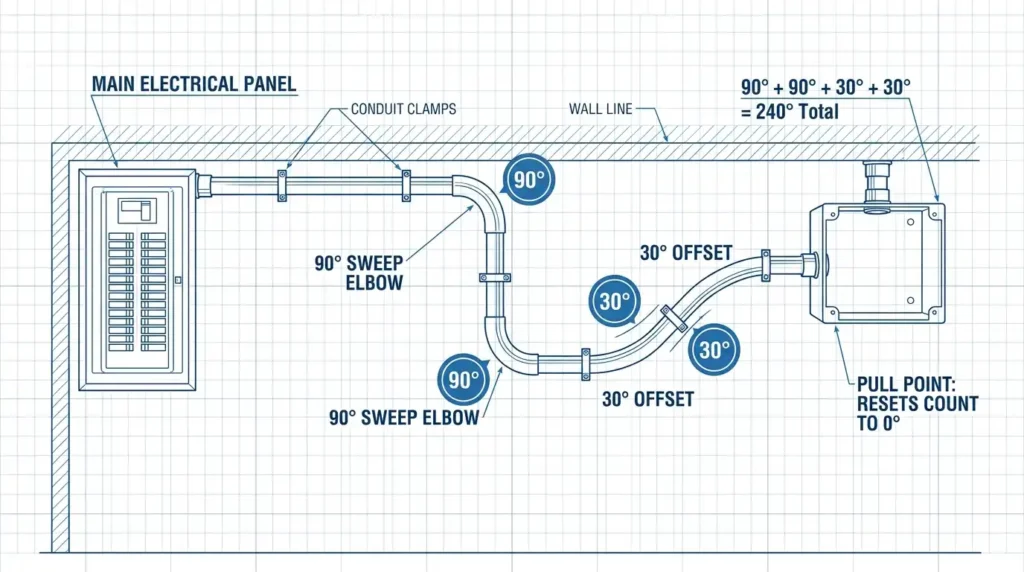
Code Cross-References Across All Conduit Types
The 360-degree maximum bend rule is a universal mechanical requirement across all raceway materials.
| Conduit Material Type | NEC Article Code Section | Maximum Allowed Bends Between Pull Points |
|---|---|---|
| EMT (Electrical Metallic Tubing) | NEC 358.26 | 360 degrees (4 quarter bends) |
| RMC (Rigid Metal Conduit) | NEC 344.26 | 360 degrees (4 quarter bends) |
| IMC (Intermediate Metal Conduit) | NEC 342.26 | 360 degrees (4 quarter bends) |
| PVC (Rigid Schedule 40 & 80) | NEC 352.26 | 360 degrees (4 quarter bends) |
| FMC (Flexible Metal Conduit) | NEC 348.26 | 360 degrees (4 quarter bends) |
| LFMC (Liquidtight Flexible Metal) | NEC 350.26 | 360 degrees (4 quarter bends) |
| LFNC (Liquidtight Nonmetallic) | NEC 356.26 | 360 degrees (4 quarter bends) |
How to Calculate Total Bend Degrees in a Run
Many apprentice electricians make the mistake of counting only major 90-degree elbows when calculating bend limits. However, building inspectors sum every single bend angle along the pipe path between pull points.
1. Standard 90-Degree Elbows
A factory sweep or field-bent 90-degree elbow equals 90 degrees. Four 90-degree elbows equal 360 degrees, which completely uses up your allowable limit for that run.
2. Offset Bends
An offset is made using two equal bends in opposite directions to change the elevation or alignment of the conduit. Both bends add degrees to your total:
- 10-Degree Offset: 10° + 10° = 20 degrees
- 15-Degree Offset: 15° + 15° = 30 degrees
- 22.5-Degree Offset: 22.5° + 22.5° = 45 degrees
- 30-Degree Offset: 30° + 30° = 60 degrees
- 45-Degree Offset: 45° + 45° = 90 degrees
3. Saddle Bends
Saddles are used to jump over obstacle pipes or obstructions:
- 3-Point Saddle: Consists of one center bend (typically 45°) and two side bends (22.5° each). Total = 45° + 22.5° + 22.5° = 90 degrees.
- 4-Point Saddle: Consists of two matching offsets (typically using four 30° bends). Total = 30° + 30° + 30° + 30° = 120 degrees.
4. Kick Bends
A kick is a single small bend (often 10 to 30 degrees) placed near an enclosure to align the conduit into a knockout. A 15-degree kick adds 15 degrees to your total.
Common Bend Configurations & Degree Value Table
| Bend Configuration Type | Individual Component Bends | Total Degrees Added to Run |
|---|---|---|
| Standard 90° Sweep / Elbow | One 90° bend | 90° |
| 45° Corner Bend | One 45° bend | 45° |
| 30° Offset | Two 30° bends | 60° |
| 45° Offset | Two 45° bends | 90° |
| 3-Point Saddle (45° Center) | One 45° center + two 22.5° sides | 90° |
| 4-Point Saddle (30° Offsets) | Four 30° bends | 120° |
| Box Kick Bend (15°) | One 15° bend | 15° |
Real-World Job-Site Calculation Examples
Scenario A: The Borderline Run
An electrician installs a conduit run from a subpanel to an outlet box. The run contains:
- Two 90-degree factory elbows (90° + 90° = 180°)
- One 30-degree offset entering a box (30° + 30° = 60°)
- One 3-point saddle over a water pipe (45° + 22.5° + 22.5° = 90°)
- One 30-degree kick into the subpanel knockout (30°)
Total Degrees = 180° + 60° + 90° + 30° = 360° Total (PASSES CODE)Scenario B: The Failed Inspection Run
An apprentice installs a commercial feeder containing:
- Three 90-degree elbows (270°)
- One 45-degree offset (45° + 45° = 90°)
- One 15-degree kick at the enclosure (15°)
Total Degrees = 270° + 90° + 15° = 375° Total (FAILS CODE BY 15 DEGREES)WARNING
The Inspection Violation: Scenario B fails inspection under NEC 358.26 because 375 degrees exceeds the 360-degree maximum limit. To pass inspection, the installer must either remove the 15-degree kick by repositioning the box or cut the conduit and insert an inline conduit body or pull box.
What Resets the 360-Degree Bend Counter?
Not every fitting in a conduit run acts as a pull point. To legally reset the cumulative bend counter back to zero, a component must provide physical access to pull and feed conductors.
Panelboard (0°) === [270° Bends] ===> Conduit Body Type LB (RESETS TO 0°) === [180° Bends] ===> Junction BoxValid Pull Points (Resets Count to 0°)
- Junction Boxes & Outlet Boxes: Metallic or nonmetallic boxes with removable covers (e.g., 4-inch square boxes, 4-11/16 boxes, gang boxes).
- Pull Boxes & Sheet Metal Enclosures: Commercial pull boxes and auxiliary gutters.
- Conduit Bodies: Threaded or set-screw fittings with removable covers, such as Type LB, C, LL, LR, T, TB, and X fittings.
- Equipment Enclosures: Main panelboards, switchboards, motor control centers, and disconnect switches.
Invalid Components (Do NOT Reset the Count)
- Standard Conduit Couplings: Set-screw, compression, or threaded couplings.
- Conduit Connectors: Standard box connectors used at knockouts.
- Conduit Sweeps & Factory Elbows: Curved conduit sections without access covers.
- Concealed or Inaccessible Boxes: Any junction box covered permanently by sheetrock, drywall, or ceiling plaster.
[!COMMON MISTAKE] The Hidden Box Trap: Installing a junction box inside a drywalled ceiling to split up a long conduit run only works if the box cover remains accessible after building finishing. Under NEC Section 314.29, boxes and conduit bodies must be accessible without removing part of the building structure. An inaccessible box does not legally qualify as a pull point.
Why the 360-Degree Rule Exists: The Engineering Physics
The 360-degree limit is based on mechanical physics rather than electrical current capacity.
The Capstan Friction Effect
When pulling conductors through a conduit bend, friction builds exponentially based on the Capstan Formula:
Pulling Tension = Incoming Tension × Exponential Factor (Friction Coefficient × Angle in Radians)Every degree of bend increases the dragging friction between the wire jacket and the conduit wall.
When total bends exceed 360 degrees, pulling tension spikes rapidly. The force required to pull the wire can easily exceed the pulling rope strength or the maximum tension allowed for the copper conductors.
Sidewall Bearing Pressure (SWBP)
As wire tension increases around a bend, the conductors are forced tightly against the inner curve of the conduit pipe. This force is called sidewall bearing pressure.
Excessive sidewall pressure crushes the conductor insulation, strips off protective nylon coatings down to bare copper, or creates invisible internal insulation fractures that lead to short circuits later.
Pro Field Tips for Managing Bend Limits
- Aim for the 270-Degree Rule: On complex commercial jobs, try to limit your conduit runs to 270 degrees (three 90s, or two 90s and two offsets). Keeping 90 degrees in reserve makes wire pulling much faster and reduces the need for heavy pulling lubricant.
- Use Conduit Bodies (Type LB / C): If structural obstacles force you to make multiple turns, install a conduit body (like an LB or C fitting) on an exterior wall or exposed ceiling. It breaks up the run cleanly and resets your count to zero.
- Opt for 30-Degree Offsets Over 45-Degree Offsets: A 30-degree offset adds only 60 degrees to your run, whereas a 45-degree offset adds 90 degrees. Using shallower offset angles preserves degrees for mandatory corner bends.
- Plan Pull Points Before Cutting Pipe: Map out your entire conduit route on paper or on the wall before bending pipe. Locate pull boxes near structural corners to keep individual runs short.
Practical Field Summary & Decision Checklist
Follow this simple field checklist to ensure 100 percent code compliance before pulling wire:
- Step 1: Identify the start point (panel, box, or conduit body) and set initial degree count to 0°.
- Step 2: Count all 90-degree elbows in the run (each = 90°).
- Step 3: Count all offset bends (e.g., two 30° bends = 60°).
- Step 4: Count all saddle bends (e.g., 3-point saddle = 90°).
- Step 5: Count all box kick bends (e.g., 15° kick = 15°).
- Step 6: Add all degree values together to get the total cumulative angle.
- Step 7: Verify that the total angle is 360 degrees or less.
- Step 8: If the total exceeds 360°, insert an accessible conduit body (LB/C) or junction box to reset the count.
Frequently Asked Questions (FAQs)
Yes. A single 45-degree elbow adds exactly 45 degrees to your cumulative bend count.
You can have a maximum of four 90-degree bends (4 × 90° = 360°) between pull points, provided there are no other offsets, saddles, or kick bends in that same run.
No. Flexible Metal Conduit (NEC 348.26) and Liquidtight Flexible Metal Conduit (NEC 350.26) both enforce the exact same 360-degree maximum limit between pull points as rigid EMT or PVC conduit.
Conduit bodies can be used for splices only if they are durably marked by the manufacturer with their internal cubic-inch volume, and if the total conductor and wire nut volume complies with NEC box fill requirements under Section 314.16(C).