
IMPORTANT
Quick Answer: Flexible raceways protect electrical conductors while allowing movement, thermal expansion, and vibration absorption. FMC (Flexible Metal Conduit) is restricted to dry indoor locations. LFMC (Liquidtight Flexible Metal Conduit) adds a waterproof jacket for wet or oily outdoor environments. LFNC (Liquidtight Flexible Nonmetallic Conduit) is entirely plastic, non-conductive, and highly corrosion-resistant. All flexible raceways require a separate equipment grounding conductor if their length exceeds 6 feet or if they supply equipment subject to vibration.
Key Takeaways
- Location Ratings: Use FMC strictly in dry locations. Use LFMC or LFNC for outdoor, wet, hose-down, or direct burial applications (where listed).
- The 6-Foot Grounding Exception: FMC and small-diameter LFMC can serve as the equipment grounding conductor only if the total ground path length does not exceed 6 feet and overcurrent protection is 20A or less (for 3/8″ and 1/2″ sizes) or 60A or less (for larger LFMC).
- LFNC Grounding Mandatory: Nonmetallic flex (LFNC) cannot conduct electricity. A green copper Equipment Grounding Conductor (EGC) must always be pulled inside.
- Support Intervals: Flexible raceways must be securely fastened within 12 inches of boxes or terminations and supported every 4.5 feet along the run, with exceptions for fished cables and 6-foot luminaire whips.
- Sizing Differences: Flexible conduits have different internal dimensions than rigid EMT or PVC pipe due to internal ridges and outer jackets. Always use the specific FMC, LFMC, or LFNC columns in NEC Chapter 9, Table 4.
Understanding Flexible & Specialty Raceways
In standard building wiring, rigid conduits like EMT, PVC, or RMC provide permanent protection along flat walls and ceilings. However, when connecting motors, HVAC equipment, transformers, or wall-mounted devices in existing buildings, rigid pipe is impossible to install.
Flexible raceways solve this problem by absorbing mechanical vibration, flexing around tight structural obstructions, and allowing equipment movement.
Quick Raceway Selection Rule:
- Dry Indoor Vibration & Short Taps: Use Flexible Metal Conduit (FMC / Greenfield).
- Outdoor, Wet & Industrial Motors: Use Liquidtight Flexible Metal Conduit (LFMC / Sealtite Metal).
- Corrosive, Washdown & Direct Burial: Use Liquidtight Flexible Nonmetallic Conduit (LFNC / Carflex).
- Finished Wall Surface Retrofits: Use Surface Raceways (Wiremold Metal or PVC).
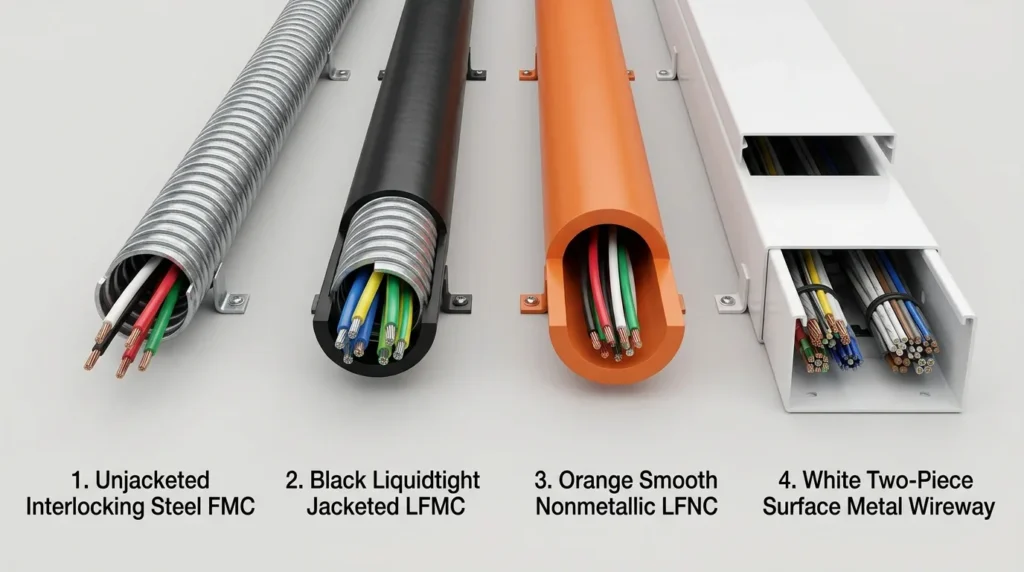
Raceway Master Comparison & Selection Matrix
Selecting the wrong flexible conduit material is a major cause of job-site inspection rejections. The table below outlines the core NEC parameters for each flexible and specialty raceway type.
| Feature | FMC (Flex Metal) | LFMC (Liquidtight Metal) | LFNC (Liquidtight Plastic) | Surface Metal Raceway |
|---|---|---|---|---|
| NEC Article Code | Article 348 | Article 350 | Article 356 | Article 386 |
| Common Trade Name | Greenfield | Sealtite / Liquidtight | Carflex / Nonmetallic Flex | Wiremold |
| Location Environment | Dry locations only | Wet, outdoor, oily | Wet, corrosive, washdown | Dry indoor finished walls |
| Can Serve as EGC (Ground)? | Yes (Max 6 ft, ≤20A) | Yes (Max 6 ft, ≤60A) | NO (Always pull EGC) | Yes (If listed metal) |
| Direct Burial Rated? | No | No (Unless listed) | Yes (Type LFNC-B listed) | No |
| Sunlight Resistant? | N/A (Indoor) | Yes (Jacketed) | Yes (Jacketed) | N/A (Indoor) |
| Standard Support Limit | 4.5 feet | 4.5 feet | 3.0 to 4.5 feet | 4.5 to 10 feet |
| Support Distance from Box | Within 12 inches | Within 12 inches | Within 12 inches | Within 12 to 24 inches |
Deep-Dive: Flexible Metal Conduit (FMC / Article 348)
Flexible Metal Conduit, commonly known in the trade as Greenfield, consists of a helically wound, interlocking zinc-coated steel or aluminum strip.
Where to Use FMC
- Connecting interior dry-type transformers to distribution panelboards to isolate hum and vibration.
- Fixture taps (whips) from ceiling junction boxes to recessed light fixtures in commercial drop ceilings.
- Interior equipment connections where walls prohibit rigid pipe bends.
NEC Restrictions for FMC
- No Wet Locations: FMC cannot be installed in wet or damp locations, underground, or embedded in poured concrete (NEC 348.12).
- No Corrosive Environments: Cannot be exposed to strong chemical fumes or battery rooms.
WARNING
The FMC Grounding Trap: Electricians frequently assume that because FMC is made of metal, it can always ground equipment. Under NEC Section 348.60, FMC can only serve as the equipment ground if the total length in the ground return path is 6 feet or less, the circuit breakers are 20 amps or less, and trade size is 3/8″ or 1/2″. If the run is 7 feet long or feeds a 30A circuit, you must pull a separate green equipment grounding conductor inside.
Deep-Dive: Liquidtight Flexible Metal Conduit (LFMC / Article 350)
Liquidtight Flexible Metal Conduit features an internal flexible metal core covered by a sunlight-resistant, liquidtight thermoplastic outer jacket.
Where to Use LFMC
- Outdoor air conditioner condenser disconnect whips.
- Industrial motor connections exposed to cutting oils, coolants, or moisture.
- Outdoor parking lot lighting base connections subject to ground moisture.
Grounding Rules for LFMC (NEC 350.60)
LFMC trade sizes 3/8 inch through 1-1/4 inch may serve as an equipment grounding conductor if:
- The total length of LFMC in the ground return path does not exceed 6 feet.
- The fittings are listed for grounding.
- The overcurrent protective device is rated 20A or less for 3/8″ and 1/2″ sizes, or 60A or less for 3/4″ through 1-1/4″ sizes.
If LFMC is installed on equipment where flexibility is required to accommodate continuous vibration (such as a motor mount), a separate grounding conductor is mandatory regardless of length.
Deep-Dive: Liquidtight Flexible Nonmetallic Conduit (LFNC / Article 356)
LFNC is a smooth-bore nonmetallic flexible raceway manufactured from PVC and reinforcing material. The most popular field type is Type LFNC-B, which features continuous rigid PVC integral reinforcement inside a flexible PVC wall.
Key Advantages of LFNC
- Zero Corrosion: Ideal for chemical plants, swimming pool pump wiring (NEC Article 680), and coastal salt-air environments.
- Direct Burial Approval: Listed Type LFNC-B is approved for direct burial in earth where permitted by specifications.
- Lightweight & Easy to Cut: Easily cut with standard PVC hand shears.
IMPORTANT
LFNC Grounding Requirement: Because LFNC contains no metal, NEC Section 356.60 requires an equipment grounding conductor to be installed in the raceway for all circuits. You can never rely on the raceway itself for grounding.
Deep-Dive: Surface Raceways (Articles 386 & 388)
Surface Metal Raceways (NEC Article 386) and Surface Nonmetallic Raceways (NEC Article 388)—commonly referenced by the brand name Wiremold—are surface-mounted multi-piece channel systems.
A surface raceway consists of a metal or plastic back base track mounted to a wall, insulated electrical conductors laid inside the channel, and a decorative snap-on top cover that encloses the assembly cleanly.
Ideal Applications
- Adding power outlets or data ports to finished brick, concrete block, or plaster walls where fishing wire inside the wall is impossible.
- School classrooms, commercial office cubicles, and laboratory workbenches requiring frequent wiring alterations.
Key Code Rules for Surface Raceways
- Dry Locations Only: Surface raceways cannot be used outdoors or in damp/wet areas.
- Protection From Physical Damage: Cannot be installed where subject to severe physical impact (e.g., lower walls in heavy industrial loading docks).
- Conductor Combination: Power conductors and low-voltage communications cables can occupy the same surface channel only if separated by a physical metal barrier.
Flexible Conduit Support Rules & 6-Foot Whip Exceptions
Securing flexible conduit correctly is a top priority during rough-in electrical inspections.
Standard Installation Rule:
Flex conduit must be securely fastened within 12 inches of every box, cabinet, or fitting, and supported at least once every 4.5 feet along continuous runs.
The Three Big Exceptions to Support Rules:
- Fished Conduit: Intermediate supports are not required where flex conduit is fished through finished walls or ceilings where securing is impossible.
- 6-Foot Luminaire Tap Whips: Flex conduit is exempt from intermediate strapping for lengths up to 6 feet measured from the fixture terminal to an outlet box in accessible ceilings.
- 6-Foot Equipment Connections: Flex conduit up to 6 feet long connected to vibrating motors or movable equipment does not require intermediate support straps.
Sizing Flex Conduits: Sizing & Fill Calculations
Flexible conduit does not share the exact same internal cross-sectional area as rigid metal or PVC pipes. Internal steel spirals and thick outer jackets reduce internal clearance.
When performing conduit fill calculations for flexible raceways, always consult the specific columns in NEC Chapter 9, Table 4:
- FMC: Table 4 Column “Flexible Metal Conduit”
- LFMC: Table 4 Column “Liquidtight Flexible Metal Conduit”
- LFNC-B: Table 4 Column “Liquidtight Flexible Nonmetallic Conduit”
[!PRO TIP] Avoid Mechanical Wire Jamming in Flex: Because flexible conduit moves and compresses during wire pulls, internal friction is significantly higher than in rigid EMT. When pulling three conductors into a flex whip, always verify that your ratio is outside the 2.8 to 3.2 danger zone to prevent physical wedging. Refer to our detailed guide on conduit jam ratio calculations before making long flex pulls.
Field Troubleshooting & Inspector Red Flags
Avoid these four common inspection failures on job sites:
- Missing Green Ground Wire in Damp Areas: Running LFMC to an outdoor A/C compressor unit without an internal green grounding conductor when the length exceeds 6 feet.
- Over-Bending Flex Radii: Bends made too sharply near fittings. NEC requires flexible conduit bends to maintain minimum radius limits to prevent internal core separation. Refer to our guide on 360-degree conduit bend limits to keep cumulative angles legal.
- Improper Fittings: Using standard EMT set-screw connectors on FMC or LFMC. Always use listed flex connectors or liquidtight compression fittings.
- Exceeding 24-Inch Nipple Rules on Short Ties: When using short flex pieces between adjacent boxes, ensure you check whether the installation qualifies under the 24-inch nipple rule for 60% fill capacity.
Practical Field Summary & Decision Checklist
Follow this step-by-step checklist to select and install flexible raceways legally:
- Step 1: Evaluate the environment (Dry indoor = FMC; Outdoor/Wet = LFMC; Corrosive/Chemical = LFNC).
- Step 2: Determine if the equipment vibrates (Vibrating motor = Pull separate EGC wire mandatory).
- Step 3: Measure overall run length (Over 6 feet = Pull separate EGC wire mandatory).
- Step 4: Select listed fittings designed specifically for the raceway type.
- Step 5: Calculate conductor cross-sectional area fill using exact flex columns in NEC Chapter 9 Table 4 (Maximum 40% fill for 3+ conductors). You can easily verify your installation parameters on our official Conduit Fill Chart.
- Step 6: Secure within 12 inches of boxes and every 4.5 feet along the run.
Frequently Asked Questions (FAQs)
No. NEC Section 348.12 explicitly prohibits FMC from being installed underground or embedded in poured concrete. For underground flexible applications, use listed direct-burial LFNC-B or approved underground LFMC.
Yes. Under NEC 348.30(B)(2), flexible metal conduit is permitted to be installed without support in accessible ceilings for lengths up to 6 feet when connecting tap conductors to recessed luminaires.
LFMC has a flexible steel or aluminum core covered by a plastic jacket, offering high mechanical crush resistance. LFNC is made entirely of nonmetallic plastic and PVC materials, offering superior chemical and corrosion resistance with zero risk of core rust.
Under NEC Chapter 9, Table 354.22 and Table 1 Note 4, a 3/8-inch trade size flexible raceway is permitted for specific fixture taps and equipment leads. Wire capacity depends on conductor size (e.g., maximum four 14 AWG THHN conductors or three 12 AWG THHN conductors in a short tap whip).